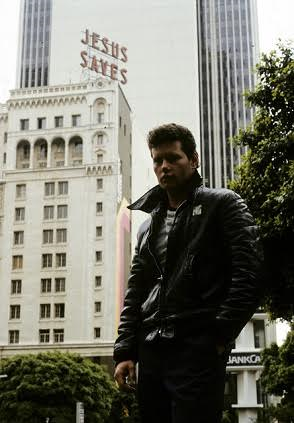
Downtown Los Angeles, circa 1983

Downtown Los Angeles, circa 1983
STMcC in downtown Los Angeles, circa 1983
Showing posts with label Art. Show all posts

Monday, April 20, 2020

DON'T GET LOST, AMERICA!

.
.
LOST AMERICA
by Troy Paiva
released: 2003
.
I received Troy Paiva's LOST AMERICA this past Christmas from the Mother of a girl I went with from 1989 to 1994, and I'd like to think that this says something positive about both her Mother and myself. The book is filled with dramatic and intriguing photographs executed by a true artist. It seems that Paiva petitioned Stan Ridgway (a Rock star) to write the Forward to LOST AMERICA, but ironically - based on what I found in the book - Ridgway isn't half the writer that Troy Paiva is. (That's right - Paiva is as good a writer as he is a photographer! This guy has really been blessed with talent!) Ridgway nails it when he says, "Some people can be obsessive. Artists usually are, and the great ones are excessively so. They are driven by an inner vision."
.
And the attempt to manifest this inner vision for the benefit of others can often come at a price for the artist. Paiva is a junky joint junkie: his vision is to take long exposure photographs at night of abandoned things and places. He attempts to capture the Lost and Lonely Heart of the Past (usually with a mixture of hot and cool colored lights illuminating certain areas of his subject matter).
.
It is important to remember when viewing these poetic and mysterious photos, that Paiva often had to pay a price for them beyond the cost of film, developing and printing: in the course of tramping through junkyards and forlorn places at night, he has been swarmed by bats, attacked by owls, and chased back to his truck by packs of wild dogs. He's had heart-stopping encounters with angry rattlesnakes and witnessed mysterious tarantula and cricket migrations. Once, a praying mantis as big as his hand followed him around an old junkyard like a pet, for most of an evening. More than once, his hand has swollen up like a balloon from painful spider bites. So, unless the idea of being stalked by a monstrous praying mantis all evening is your idea of a fun Friday night, you shouldn't take these very cool photos for granted.
.
As I said, Troy Paiva's writing impressed me as much as his photographs did, and on page 14 he writes, "The songs of old broken things are everywhere". The moment I read that, the perfect song sprang into my mind. Composed by another artist with the poetic heart of a juice joint junkie (Tom Waits) is the song, 'BROKEN BICYCLES' from the movie soundtrack for 'One From The Heart':
.
"Broken bicycles, old busted chains 
With rusted handle bars, out in the rain 
Somebody must have an orphanage for 
All these things that nobody wants any more" 
.
Well, there IS an orphanage for these abandoned things and it's called, "Troy Paiva's Camera". Let Tom sing the song while you explore Paiva's photos, and you will have discovered a match made in the junkyard of your dreams!
.
Now, I will confess that there are a few times when I feel Paiva's lighting is detrimental to the image. Occasionally the colored lights infuse the scene with an artificiality that spoils it. Nowhere is this more evident than in 'Daggett Beams, 2000' in which an otherwise truly stunning photo is spoiled by a harsh yellow spotlight in the background. I sometimes preferred his photos with less intrusive, minimal lighting. For example: the moody blue 'Road Closed, 2001' which features two battered, old pickup trucks parked like sentinels under an unhappy Winter sky.
.
But most of his photos do feature spotlighted areas of red, green, blue or yellow - this is Paiva's style - and the vast majority of the time, it works; it adds a sense of supernatural foreboding, or Little Boy Lost to his "Broken Bicycle" scenes.
.
Some of the real standouts for me are 'Ludlow Cafe, 1990'; 'Concourse, 2001'; 'Salton Sea Beach Trailer, 1992' (so creepy that I could probably write an entire horror story around that one image); 'Cabover And Tires, 1992' - maybe my favorite photo in the book. Who or WHAT might live in that abandoned camper? I think I'd rather not know! And then there's 'The King, 2002', which looks like some nightmarish image from a bizarre, childlike somnambulistic landscape - Alice in Vegasland! Quickly click those heels and scream, "There's no place like home!"
.
Many of Paiva's photos would make great imagination-starters for would-be writers.
.
'CL, 2001' shows us the dilapidated snack bar of the abandoned Burlingame Drive-in Theatre. In the foreground is an old sign, with the only remaining letters on it being "CL." The caption states, "So far past being closed, it's only CL now." I told you this guy could write!
.
Chapter Four, titled "Salvage", contains several shots of old and weathered Las Vegas casino signs taken in the Vegas Neon Museum's "boneyard." It's interesting to note that the scene in the movie, 'One From The Heart' in which the plaintive Tom Waits song 'Broken Bicycles' plays, occurs in a Las Vegas junkyard littered with old, dismantled casino signs, and a mournful train whistling in the background. I never imagined that such a place really existed... until I got LOST AMERICA. The book is sure to appeal to every melancholy weirdo like me, and I would recommend you buy it, except for one thing: it was printed in China...
.
Yes, this is the same China that embraces Communism - a failed economic / social system responsible for murdering approximately 100 million human beings worldwide, and torturing and starving many millions more. The same China that enforces its one-child family policy with forced abortions. The same China that got caught smuggling AK-47s into the U.S. to be sold to Los Angeles street gangs; threatened to nuke L.A. if the U.S. militarily defends Taiwan; kills its citizens who have the audacity to publicly request freedom; sells body parts of executed prisoners to medical facilities; enslaves political opponents & Christians for their faith, and puts them to work in forced labor camps, producing all imaginable types of goods, and printing books, all to be sold to Americans.
.
Every time we purchase a Chinese-made product, we are feeding the human rights-abusing monster that has made no secret of its hatred for us - a monster that is increasing its military might at an astonishing rate and will someday overrun its neighbor, Taiwan, and declare war on the United States. Let's have a little foresight for once. Let's stop building our enemies. Let's boycott ALL Chinese products and sleep better at night.
.
LOST AMERICA is a nice book, but until it is being produced in a country that values human life, it's a book that we can LIVE WITHOUT! (Of course, if you're buying a used copy, this is not an issue.) The good news, however, is that many of Troy Paiva's photos can be viewed at his lostamerica website. It may not be this book, but it's still worth a look.
.
~ Stephen T. McCarthy
.

Friday, August 23, 2019

"AND STILL THOSE VOICES ARE CALLING FROM FAR AWAY..."*

.
.
SOUTHERN CALIFORNIALAND
by Charles Phoenix
2004
.
[*Lyric from the song, 'HOTEL CALIFORNIA' by The Eagles.]
.
I acquired SOUTHERN CALIFORNIALAND by Charles Phoenix just over a week ago in a Christmas gift exchange game. The book is a true celebration of Southern California in its glorious, paradisiacal decades of 1940 through the 1970s. Charles Phoenix who oddly became obsessed with the old 35 mm Kodachrome slides taken by strangers in memorializing their family trips, gatherings, and everyday lives, shares about 150 of his favorites with us in this absolutely charming book. His love and enthusiasm for his subject (SoCal in its glory days) just oozes from every page. Like the author, I grew up in SoCalLand in the '60s & 70s, and so I share his fascination for the magic that it once held.
.
Enchanting, dreamy, nostalgic, and a tad melancholic (because the enchantment and the dream has been reduced to nostalgia) are words that best describe this picture book. But "surprising" is another word that fits, because I was surprised by the wealth of information to be found in the brief text that accompanies each photograph. Even I - who has traversed so many of these locations - learned some interesting bits of trivia.
.
For example: Did you know that when Vice President Richard Nixon cut the ribbon and became the Disneyland Monorail's first official passenger, unbeknownst to that famous rider, it was the first time the unique transportation train completed a trip without catching fire? Phoenix describes Walt Disney as being very nervous. Yeah, I suppose he was! Did you know that the Luer "Quality Meat" Rocket (a forerunner to the Oscar Meyer Wienermobile) was discovered in a Prescott, Arizona junkyard in 1997, "weathered, but restorable"? (And here I always thought that I was the only good thing to wrench free from the evil clutches of Prescott! I made good my escape in early '94, also "weathered, but restorable".)
.
I loved perusing the lost details of places where I have traipsed: the famous Brown Derby restaurant and the Pan-Pacific Auditorium; White Front of Anaheim, one of the discount chain of stores fo' po' folks. (My Ma used to drag us to one as children in Orange County. I don't know how many the O.C. boasted of, but this might well be the same White Front.); the Pacific Ocean Park amusement park, which I guarded as a young Police Explorer during its demolition in the Winter of 1973-74; the L.A. International Airport Theme Building where I experienced my first Red Dog beer. The beer wasn't memorable, but the location was.
.
Phoenix includes insightful and sometimes funny commentary. When he describes the cover photo (a white, 1955 Cadillac Eldorado Biarritz convertible parked near the corner of Walnut & Allen in Pasadena, with palm trees, an orange grove, and snow-capped Mt. Baldy in the background) as "a perfect Southern California shot", he's right on the money! When he writes of the 1954 Mineral Baths photo in Desert Hot Springs, "Hundreds of thousands of acres of beautiful undisturbed desert scenery and someone had to build a wall around this place and paint in [desert] scenery," it's genuinely funny.
.
This book is a treasure trove for any pre-Hotel California SoCalLand lover. Where else are you going to find a photograph of a 1956 teenager with the perfect ducktail waiting to test Disneyland's Autopia track? Or a photo of President Eisenhower blowing his nose in Palm Springs? Or a photo of Lee and Katie Kellogg eating meatloaf sandwiches in 1955 Alhambra? This book is a vibrant, eye-popping gem of pop culture which I urge you not to buy.
.
I'd rather you didn't purchase this fun Charles Phoenix book. Why? Because on page 144 we learn that SOUTHERN CALIFORNILAND was "Printed in China". Yes, this is the same China that embraces Communism, a failed economic/social system responsible for murdering approximately 100 million human beings worldwide, and torturing and starving many millions more. The same China that enforces its one-child family policy with forced abortions. The same China that got caught smuggling AK-47s into the U.S. to be sold to Los Angeles street gangs; threatened to nuke L.A. if the U.S. militarily defends Taiwan; kills its citizens who have the audacity to publicly request freedom; sells body parts of executed prisoners to medical facilities; enslaves political opponents and Christians for their faith, and puts them to work in forced labor camps, producing all imaginable types of goods, and printing books, all to be sold to Americans.
.
Every time we purchase a Chinese-made product, we are feeding the human rights-abusing monster that has made no secret of its hatred for us - a monster that is increasing its military might at an astonishing rate and will someday overrun its neighbor, Taiwan, and declare war on the United States. Let's have a little foresight for once. Let's stop building our enemies. Let's boycott ALL Chinese products and sleep better at night. SOUTHERN CALIFORNIALAND is a nice book, but until it is being produced in a country that values human life, it's a book that we can LIVE WITHOUT! (Of course, if you're buying a used copy, this is not an issue.)
.
~ Stephen T. McCarthy
.

Tuesday, August 7, 2018

HOPPER-HOPPING WITH GAIL LEVIN

.
.
HOPPER'S PLACES
by Gail Levin
published: 1985
.
There's a TWILIGHT ZONE episode titled 'A KIND OF STOPWATCH' which starred Richard Erdman and was first broadcasted in October of 1963. The story is about a man who is able to freeze time by suspending the progress of the second hand on an enchanted stopwatch. He instantaneously stops time in order to rob a bank and accidentally breaks the stopwatch in the process, leaving him stranded alone forever in a timeless, lifeless world. I saw the episode as a child and it immediately captivated me, and something about that imagery has haunted me ever since. EDWARD HOPPER is my favorite artist and there's a "timeless isolationism" -- a Twilight Zone-ish quality -- to his oeuvre that I really resonate to. (Don't worry! I don't intend to psychoanalyze myself here. Although my Mother DID disenroll me from kindergarten when, because of my withdrawn nature, my teacher described me as "antisocial." My Ma employed the obvious solution to that malady and took me out of school!)
.
HOPPER's works convey this intense internal aloneness by merely hinting at details in big spaces, depicting daytime shadows sparsely and yet placing almost everything in a serene (often golden) glow. His pictures rarely illustrate the sharp, mind-numbing dead of Winter or the harsh and draining dog days of Summer. Regardless of the time of year in which he worked, in Hopper's world it is perpetually Autumn. Dreamy. Quiet. Lonely. Sad. But how he captured that mood cannot be fully fathomed through mere observable techniques. It was Mr. Melancholy's inner vision that was his real "style", and this comes across so brilliantly in GAIL LEVIN's wonder-filled book, 'HOPPER'S PLACES'.
.
Having served as curator of the Hopper Collection at the Whitney Museum, and having written and compiled 'EDWARD HOPPER: AN INTIMATE BIOGRAPHY' and 'A CATALOGUE RAISONNE' (as well as many other Hopper related titles), Gail Levin is probably the foremost expert on the man and his work, and eminently qualified to be our tour guide as we go Hopper-hopping through 3 countries in search of his subjects. Levin's photographs duplicating the sights and angles that Hopper put on canvas really highlight the unique "eye" for scenes that, via his singular process of artistic alchemy, the painter was able to transform into the HOPPER ZONE.
.
HOPPER'S PLACES records many of my favorites: EAST WIND OVER WEEHAWKEN (1934); SHAKESPEARE AT DUSK ('35); APPROACHING A CITY ('46); LIGHTHOUSE HILL ('27); ADAM'S HOUSE ('28); and the utterly fascinating, ROOMS FOR TOURISTS ('45). I can see how this bed & breakfast place depicted at night might elicit diametrically different responses from a variety of observers: "I ain't going in there; that's where Norman Bates lives!" or "God dwells there and He invites me to leave the darkness and come into the Light."
.
Unfortunately, because Levin was unable to provide comparative photos for them, a few really choice Hoppers were excluded from this book. Notably, DRUG STORE (1927); EARLY SUNDAY MORNING ('30); SEVEN A.M. ('48); and Edward Hopper's ubiquitous masterpiece, NIGHTHAWKS (1942). Incidentally, this shopping mall poster gallery and post card favorite was the inspiration for the title of the Tom Waits "live" studio album 'NIGHTHAWKS AT THE DINER', which in turn was the inspiration for one of Amazon's best customer reviews -- Kippy Lanker's review titled [link> 'IN THE OLDEST BAR IN NEVADA...'
.
Once upon a time, I had entertained the idea of a career in art (another fatality on my Boulevard Of Broken Dreams), but in discovering the work of Edward Hopper, I realized that my pictures had already been put on canvas and better than I could have hoped to paint them myself. HOPPER'S PLACES is a "must own" book for any fan of the man's work, or for anyone who simply wants to SEE the definition of "art."
.
"Mamas, don't let your babies grow up to be cowboys," Waylon & Willie sang in 1978, "because they'll never stay home and they're always alone, even with someone they love". But then, of course, if your babies should happen to display an aptitude with pen and brush, you just might want to ship 'em off to art school.

.
~ Stephen T. McCarthy
.

Thursday, January 11, 2018

WET DREAMS

.
.
THE CALIFORNIA STYLE: 
California Watercolor Artists 1925-1955
edited by: Gordon McClelland & Jay Last
published: 1985
.
THE CALIFORNIA STYLE is an absolutely gorgeous book that I wouldn't even dream of giving less than 5 Stars to! 
.
There is a small 2-shelf bookcase that sits next to my bed and it holds my irreplaceable treasures, condensed into one space so that they could all be gathered quickly in the event of some "disaster." Here you find my HOLY BIBLE (with 24 years' worth of notes); my 1st edition copy of Mark Twain's ROUGHING IT; WORKS OF HENRY DAVID THOREAU, given to me by a friend only a few years before he was killed by a car thief attempting to outrun the police. Here is one of the very greatest American novels, A TREE GROWS IN BROOKLYN -- a birthday gift from my parents; WATERING THE TREE OF LIBERTY, the autobiography of my idol, the counter-revolutionary Norwegian General, Yoey O'Dogherty; and all of my old sketch books; and my unpublished writings (which, incidentally, only outnumber my published writings 321.5 to 0.) And here you'll also find... THE CALIFORNIA STYLE! 
.
I discovered THE CALIFORNIA STYLE in the UCLA bookstore when I worked on the campus in the late 1980's and I was immediately captivated by it. I went back to look through it time after time. I'd visit it before reporting to work and again during my dinner break. Day after day, night after night this went on. After a week, I heard that belligerent voice in my head that so often got me into trouble, and the voice said: {"Wassamotta U, Stephen? G'wan an' buy da damn book awready! Gid id over wid, will ya?!"} So I did, and I've never regretted it. It was the first and only time that the voice gave me good advice. How many times I've escaped into the pages of this book, sucked into a rich kaleidoscope of places, activities, fantasies and the mysteries of other times and worlds! 
.
The title is a bit of a misnomer in that there is no real stylistic commonality to be found throughout these paintings. The name derives from the fact that all of these watercolorists worked (and often taught) in California between the years of '25 and '55. 
.
The reproductions are entrancing, gorgeous. And the myriad styles, subjects, and techniques are executed masterfully. Prior to finding this book, I had mistakenly thought of watercolor as the poor artist's medium -- Oil Paint's snot-nosed little brother. Ah, how wrong I was! I now doubt that the variety of effects obtainable in watercolor can be effectively duplicated by the greatest artists in any other medium. 
.
These pictures draw your eyes like a vacuum and beg you to study them slowly, carefully. Experience the lonely, somber tones of Gretzner's 1950's LOBSTER HOUSE - MONTEREY; feel the heat emanating from Gibson's 1950's SOLEDAD CROSSING; explore the frozen moment of midday light in Teague's 1960's SOL Y SOMBRA; squint into the blue breeze of Irving's 1950's SWINGING SIGN; sing with the pastels of Wachtel's 1930's SYCAMORES; melt into the liquid thoughts of Robert's pensive girl in the 1950's DAYDREAMS; or laugh with the playful looseness of Johnson's 1930's I STREET BRIDGE, which looks like it could have modeled for the background cells of Disney's '101 Dalmations'. There's so much loveliness here that I hardly know where to start! 
.
I actually credit this book, along with the works of Edward Hopper (my favorite artist), for teaching me the meaning of "authentic" art. 
.
If you can find a copy of it, you'll likely also find that this book is not cheap today. But if it makes you feel any better, I bought my copy for a hefty $50.+ back in '88! Taking into account 16 years of inflation and its current scarcity, the steep asking price for a used copy of THE CALIFORNIA STYLE is not so out of line. 
.
Like the pictures in my high school yearbooks -- which this book abuts in my bookcase -- the pictures in THE CALIFORNIA STYLE may represent images from a distant past, but this makes them treasures all the more! 
.
~ Stephen T. McCarthy
.

Sunday, February 19, 2017

BLACK AND WHITE AND COOL

.
.
JAMES DEAN: FIFTY YEARS AGO
by Dennis Stock
published: 2005
.
My good friend Carole sent me a copy of an official publication from a JAMES DEAN fan club. Inside was a lengthy story she had written recounting the 1988 trip that she and six other “die-hard Dean fans” (including Jimmy’s boyhood friend, Bob Pulley) made to California, during which I escorted the group to several of the prominent Dean-related sites in Los Angeles. Happily reliving those days through Carole’s recollections, I was inspired to lose myself in my copy of Dennis Stock’s JAMES DEAN REVISITED. His JAMES DEAN: FIFTY YEARS AGO is essentially a special, retitled hardcover reissue with the photographs beautifully enlarged, and a few splendid ones previously unpublished now included.
.
My copy of the original –- a gift from my employer in 1993 -– is inscribed, “To a fellow alien who straddles two worlds. …the art is in the living.” My magazine-publishing boss bought me the book, but being a major fan, naturally, this essential book for Dean fans was already in my bookcase. I subsequently gave away my older copy and kept his gift.
.
As a wannabe actor fresh out of high school in 1977 (Santa Monica High, coincidentally also known as Dawson High in REBEL WITHOUT A CAUSE), I discovered Dean at a Fox Venice Theater showing of what I consider Dean’s greatest film, EAST OF EDEN. This was before movies were available for purchase and home viewing. I was mesmerized, then knocked out of my boots; everything struck a chord of harmony within me: the sense of youthful alienation; the brooding intensity; the moodiness; the frustration; the quest for meaning. I was hooked, and James Dean became my idol.
.
In September of 1980, I took my first extensive solo trip, flying into Indianapolis and then driving to Dean’s hometown, Fairmount, for the festival honoring the 25th anniversary of his death.
.
Through happenstance (?), I met Carole and her friend Russ (both would remain my very good friends). I’d heard that Martin Sheen was to attend the festival, and when Russ asked if I wanted to accompany them to the Indianapolis airport to pick up “Martin”, I said, “Sure” –- assuming that the “first name only” implied that this Martin was famous and a last name was unnecessary.
.
It turned out to be Martin, hard-core fan flying in from England. (I’m still in touch with this non-Sheen “Martin”, too.) Well, in the days that followed, my disappointment from the “Martin Mix-up” turned to elation when I discovered how well-connected my new friends were, and I found myself meeting Adeline Nall, Jimmy’s high school drama teacher, and then getting a private tour of his boyhood farmhouse conducted by the aunt who raised him, Ortense Dean Winslow. I saw his motorcycle and leather motorcycle jacket, his bongo drum sitting quietly in the corner, and his childhood artwork hanging on his old bedroom walls. Very heady stuff for a young fan! (I’ve experienced so many strange “coincidences” in my 47 years [*now 57 years*] that I’m not at all convinced this life is “real.”)
.
Well, as the years wore on, I surprisingly lost interest in acting, and a series of Spiritual episodes completely changed me and my world-view. I no longer idolize human beings, but I still recognize that James Dean was (and remains) the most imaginative, most innately gifted American actor. The direction hinted at in GIANT gives an indication of where he was pointed as an artist, and ultimately he would have emerged as a “giant” of a film director. He may have started life as a hayseed, ending it with a Turnupseed and with life’s promising highway left unexplored before him, but JAMES DEAN LIVES, both in his three films and in these beautiful black and white photographs by the fine lensman, Dennis Stock.
.
Do you wish to see why the name James Dean turns up in the songs of Rock stars? (David Essex, Lou Reed, John Mellencamp, Ian Hunter, and The Eagles, to name but five.) Want to see why all the boys wanted to BE him, and all the girls wanted to BE WITH him? (As a female friend recently wrote regarding his performance in East Of Eden: “I think Dean also aroused a lot of maternal feelings with that performance. You're attracted to him, but you also want to mother him. What's a girl to do?”) Well, it’s all in these pages:
.
The Offbeat Humor: Encircled by calves and pigs, Jim sits with his bongo drum on a patch of ground on the family’s farm and bangs out a “rhythm to moo and oink to.”
.
The Bizarre Morbidity: Jimmy posing in a coffin at a Fairmount funeral home just 7 months before his corpse would be taken there.
.
.
More Bizarre Morbidity: Jim examining the chicken head held by a small, joyful girl loitering on a New York sidewalk, while the girl’s older sister holds onto the leash of their disinterested dog.
.
.
The Eerily Mysterious: He sits dressed in coat and tie, reading a book in the farm’s hayloft while light filtering in reveals him to be surrounded by spider web-sealed old trunks. (A dynamite piece of photography! Absolutely first-rate.)
.
.
The Classic Cool: James Dean marches through the city streets, cigarette dangling and shoulders hunched in his overcoat against a Times Square rain.
.
The Ultimate Rebellion: An edgy Dean holding a gun point-blank on future president Ronald Reagan on the Hollywood set of the television play THE DARK, DARK HOUSE.
.
These and so many more stellar shots -- some posed and some candid -- await the James Dean fan on these pages. The decades have whittled down my once massive Dean collection to just a few portrait reproduction post cards sent to me by the late artist Kenneth Kendall, who sculpted the actor’s bust on display at The Griffith Park Observatory in L.A., and to the book of 1955 photographs by Dennis Stock. This should tell you plenty about the quality of these photos.
.
Come and “see” the original Voice of teen angst, the red-jacketed rebel "In Glorious Black & White".
.
~ Stephen T. McCarthy
.

Friday, January 6, 2017

THE EDDIE VAN HALEN OF ART FILMS!

.
.
KOYAANISQATSI
by Godfrey Reggio
1983
 
.
Stephen T. McCarthy here with another Retro Theatre review from the vault.
.
Some of us are too young to remember just where we were when it was first announced that President Kennedy had been shot. But if you're near my age, you may remember quite well where you were when you first heard VAN HALEN's eponymous debut album in 1978. (I was riding in Al DiMente's Cougar.)
.
For those of us who were members in the "Disco Sucks" Club, it was like suddenly discovering The Holy Grail of Rock guitar albums. Remember your jaw dropping open while hearing ERUPTION and wondering if it was really possible that this sound was emanating from a guitar and not a synthesizer?

.
That album revolutionized the electric guitar in the context of Rock 'N' Roll. (Eddie Van Halen "reinvented" the guitar according to Frank Zappa.) Of course, practically every Hard Rock guitarist since then has "borrowed" Eddie's technique to the point that a 20-year-old hearing that 'Van Halen' album for the first time today might say, "What's the big deal? This is nothing special." Little does our hypothetical "kid" know that THIS is where it all began.
.
The same could be said for Godfrey Reggio's KOYAANISQATSI. When it first hit the theatres in 1983, it was truly a mind-blowing experience. I recall being absolutely dazzled and dragging everybody I knew to that little theatre in West Los Angeles. In the following weeks, I must have seen it 8 times or more! 

.
The concept and the mesmerizing cinematography was as revolutionary as Eddie's guitar had been. In the ensuing 21 years, Reggio's cinematic style has been plagiarized to the point that a youngster viewing this film for the first time today might find it passe. But if "imitation is the sincerest form of flattery", then KOYAANISQATSI occupies an honored position among the most highly regarded films in history, as so many other filmmakers later copied his style. Not a day goes by that several commercials being shown on the boob tube don't obviously exhibit KOY's influence! But THIS was the progenitor, and it's STILL brilliant! 
.
I have often thought that one could pause this movie at any point and the image on the screen would almost always be suitable for framing and displaying. Clips of clouds seemingly alive and on a caffeine & cayenne buzz; buildings imploding; freeway traffic taking on the appearance of blood coursing through arteries; society's underdogs lost and meandering through the metropolitan jungles; and the shot of exploded rocket residue tumbling through eternity...
.
What did it all mean? KOYAANISQATSI has been described as everything from "socialist propaganda" to "a call for rediscovering God". It will appeal primarily to the person who is capable of comprehending symbolism and thinking abstractly. I'm not presumptuous enough to tell you how I think you ought to approach it, but if KOYAANISQATSI doesn't get the gears turning up in your attic, then you, my friend, need to replace your cranial duracell!
.
This ain't no cartoon, folks; this is serious business! Don't expect to find yourself in a jovial mood after viewing this masterpiece of filmmaking. You should be pensive or locked-up. (Although the movie does contain a couple of humorous moments: If you don't think that a shot of endless wieners being conveyed through a meat processing plant juxtaposed with an endless stream of human beings conveyed via escalator is funny, "then you'd better not go to college.")
.
To this day, KOY is my all-time favorite film. The finest artistic achievements affect a person on both an emotional AND a cerebral level. KOY does that. Even all these years later, I cannot watch it without seeing the world differently for days or weeks afterwards. I think everybody should view this film at least once in their lifetime.
.

Link: KOYAANISQATSI (Must-See!) Movie Trailer 
.
Even though Eddie Van Halen's guitar technique has been duplicated ad nauseam, he will be remembered as one of the very greatest because he did it FIRST. KOYAANISQATSI is far more meaningful to me because not only was it the first of its kind, but it packs a greater wallop than just lightning fingers tapping on a fretboard. 

.
Uh-oh! Although there is considerably more that I would like to express about this monumental film, I see that I have very nearly exhausted my allotment of letters, and so I guess I had better cut this review short now and just say goodb
.

Tuesday, January 3, 2017

EXPLORE THE WEST (With A Cup Of Coffee)

.

.
'WESTERN LIGHT'
featuring music from Windham Hill artists
1984
.
Remember when you were 5 years old and you were the toughest, fastest-shootin' lawman in the Old West? The large family dog was your faithful steed, and the Indian warrior hiding in them thar rocks was really just your kid brother ducking behind your dad's favorite TV chair. Face it, there is a cherished residue from those wonderful years tucked into a pocket of your heart, and you still carry it around and examine it from time to time. Hey, that's OK -- not OK Corral, but OK.
.
Well, guess what! You can still explore The West from the comfort of your own living room! It is the first-class photography that makes Windham Hill's 'WESTERN LIGHT' a stellar video travelogue. Myriad magical Western places are explored by the sympathetic camera, including Monument Valley on the Utah / Airheadzona border (made famous in John Ford's Westerns) and Bodie, the California State Historic Park, which is probably the best preserved Nineteenth Century ghost town in America.
.
The concept & cinematography style were obviously "borrowed" from the masterpiece film KOYAANISQATSI, which had been released just a year earlier in 1983.
.
For those of you who are interested in the technical aspects of such things: Kodak 7291 and 7294 film stock was used and transferred to video tape for editing. The final 1" videotape edited master and the 1" 1610 PCM digital audio source were then transferred to VHS and Beta stereo Hi-fi videocassettes. Three basic 16mm cameras were used. The ground shots (at 30 frames per second) were done with a high speed Arriflex 16SR, the aerial footage was shot with an Eclair from a fixed wing mount and a Bolex was used for the time lapse photography. Three different lenses were used: a fixed 5.9, a 10-150 zoom and a 12-240 zoom. Various filters were used throughout including a coral-3, a fog filter and a polarizing filter. I don't know what most of that means, but it sounds as impressive as the results look!
.
At a time when we have grown accustomed to sound-bites and jump-cuts, here the camera rebels by lovingly and leisurely caressing the Western landscape, giving the viewer ample time to experience its nuance. The slightly "new age" soundtrack is made up of instrumental pieces from a variety of Windham Hill artists. What on paper would seem to be a very odd marriage indeed, turns out to be a surprisingly perfect tandem. Many's the night I've come home from work and unwound by viewing this extraordinarily beautiful production. At 55 minutes running time, this is perhaps the one DVD in my collection which has been played more than any other. Highly recommended! This is the next best thing to being in the West... on horseback.
.
~ Stephen T. McCarthy
.