.
.
THE ROY ROGERS COLLECTION
Roy Rogers DVD Boxed Set
released: 2006
.
A lot of folks don’t know that ROY ROGERS (Leonard Slye; 1911-1998) was born at approximately where 2nd base in Cincinnati’s old Riverfront Stadium would eventually be located. How American is that? It’s a wonder he didn’t emerge from the womb draped in The Stars And Stripes, holding aloft an apple pie still hot from “the oven” and whistling ‘Yankee Doodle Dandy’ (or ‘Take Me Out To The Ballgame’). Every time Pete Rose slid into 2nd base, ol’ Roy probably thought that the Reds had scored a run because Charlie Hustle was safe at “home.”
.
Roy Rogers was one of my great heroes when I was a kid, and I can still recall the pride with which I wore my bright yellow raincoat with the black pictures printed on it of Roy (“King Of The Cowboys”), Trigger (“The Smartest Horse In The Movies"), and Dale Evans (“The Queen Of The West”). I even had a little schoolboy crush on Roy’s wife, Dale.
.
These old “B” Westerns starring Roy were so wholesome and exuded such innocence that I can’t help saddling up from time to time with my old hero and revisiting a simpler, more pleasant bygone time that won’t be riding our way again. Heaven? Well, it can’t be much better than lounging around late on a Saturday morning in cotton flannel jamas, with hot coffee, and watching Roy round up rustlers. “Look out behind that rock, Roy!” Too late. Oh well, Roy will ultimately win the fight (even if he does consistently “fall” for that leg sweep trick) because the good guys and bad guys are always clearly delineated in “B” Westerns and the good guys always win. And what’s wrong wit dat?
.
.
In 1990, my girlfriend and I self-published "CALAMITY CAT'S AND BLACK COLE KID'S UNCOMPLICATED GUIDE TO WESTERN MOVIES FOR THE SIMPLE-MINDED COWPERSON." It’s quite a collector’s item now; I’ve even heard of some copies selling for as much as ten cents! Calamity Cat and I saw every Western you can think of (and plenty that you can’t). On September 7, 1990, we drove out to the Roy Rogers Museum in Victorville, California, and since The Good Lord had taken a liking to us, we actually met Roy and Dale. I recognized that distinctive “double rolled” crown of his cowboy hat as he drove past in a van. “It’s him!” I yelled. “Cut him off at the pass!”, Calamity demanded. I was really going to attempt to box him into the parking lot with my car (Calamity and I were both temporarily insane), but he pulled over of his own volition.
.
When Roy said he no longer signed autographs, Calamity and I were crushed. He added, “But we’ll be happy to have our picture taken with you.” Yeah, sure. We watched Roy work the crowd for awhile and then as someone started to hustle him off, he stopped and said, “Wait! You two wanted a picture, didn’t you?” We couldn’t believe it! He and Dale posed with us, and Roy insisted that a second shot be taken just in case the first one didn't turn out well. (I later tried to feed Trigger a handful of oats but he refused to take a bite as he was already stuffed.) We were so eager to see the pictures that Calamity and I went to a one-hour photo joint in Victorville and waited while the film was processed.
.
Roy Rogers was probably the most famous of the old “singing cowboys”, but don’t make the mistake of thinking that the “singing” part was just a movie production gimmick. Roy was a founding member of the renowned and influential Country-Western group THE SONS OF THE PIONEERS, and he had a d*mn fine voice and really knew how to swing. There was nothing “B” about Roy’s vocals! No, sir – he was the real McCoy when it came to music. And by all accounts, one of the nicest gentlemen in the history of Hollywood. (But then there’s never been a lot of competition in Tinsel Town in that department.)
.
Although the audio/visual quality of some of these old prints is pretty ragged at times, you’re getting 20 of Roy’s classic Westerns (2 in Trucolor – which is something of a small fib) for a dern low price. Will you find a better deal anywhere? “Neigh.” Included is 1944's historic “COWBOY AND THE SENORITA” (the first time Roy and Dale appeared in a film together) and perennial favorites of the Roy Rogers fan clubs, “KING OF THE COWBOYS”, “ROBIN HOOD OF THE PECOS”, and “MY PAL TRIGGER” which chronicles the birth of Roy’s famous palomino.
.
For this little wrangler, the inclusion of my three favorite R.R. pictures alone made this DVD worth the price:
.
“HELDORADO” has Nevada Ranger Roy tracking counterfeiters in Las Vegas. It includes the quintessential old coot sidekick, GABBY HAYES (“Pershnickety females!”); the rubber-faced pre-Jim Carrey Jim Carrey, PAT BRADY, who sings the wonderfully comic “I’m A High-Strung Lad”; Roy’s great line when he rescues Dale from a locked refrigerator (I won’t spoil it); and concludes with an astounding shot of what downtown Las Vegas looked like in 1946!
.
“BELLS OF SAN ANGELO” (1942, in Trucolor) has some great songs (including THE SONS OF THE PIONEERS doing “Lazy Day” and Brady’s manic antics over “Hot Lead.”)
.
And I suppose my favorite is “UNDER CALIFORNIA STARS” (1948, in Trucolor) which in a sense is an archetypal “B” Western. It commemorated Roy’s 10th anniversary in motion pictures and he and THE SONS revisited “Dust”, the featured song in Roy’s very first movie. The story revolves around the kidnapping of Trigger, a lame little boy, Ted, and his scruffy ragamuffin dog named... what else?... “Tramp”. At one point, Trigger stomps on the face of a prostrated “inflatable” villain (HOO!-HOO!-HOO! Watch in slow motion for capital “B”, “B”ad special effect laughter) and this movie contains perhaps the meanest, most downright ornery thing Roy ever uttered on the silver screen... brace yourself now: “IT’S TOO BAD A KID LIKE TED HAD TO GET HIMSELF MIXED UP WITH A NO GOOD GUY LIKE YOU!” But don’t worry, Roy will eventually get Trigger back and get the best doctor in the country to heal Ted’s leg. Everything’s Gonna “B” OK (EGBOK).
.
Unfortunately, the Mill Creek Entertainment company felt it necessary to display their logo in the bottom right corner of the screen every so often, but really, what does that matter? I mean, you’re viewing movies in which the good guys chase the bad guys on horseback around the very same rock formations from one movie to the next (watch them boulders, some of them are like recurring characters!)
.
Nevertheless, mind your tongue around me! As I wrote in the out-of-print Western movie guide that Calamity Cat and I created: “Let me spell it out for you... I don’t give an armadillo’s tail in Texas what you think of his movies, but you best not say not nice things about MY Mr. Rogers when I’m around, lest your butt and my metal-tipped cowboy boots get acquainted!”
.
Well, ‘Happy Trails To You’ until I review again.
.
~ Stephen T. McCarthy
.
A blog wherein I review everything from "Avocados" to "Zevon, Warren". Many of these reviews were originally published at Amazon.com and remained there -- some for as long as 12 years -- until some meanspirited woman, a "Bernice Fife" Know-It-All and "Glenda Beck" NeoCon, prompted BigBitch.com to delete them in late 2016.
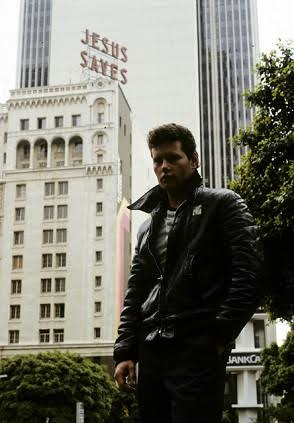
Downtown Los Angeles, circa 1983
STMcC in downtown Los Angeles, circa 1983
Showing posts with label Westerns. Show all posts
Monday, May 20, 2019
Monday, April 23, 2018
You’ll Need A Bottle Of “MESCAL” To Get Through This One!
.
.
THE QUICK AND THE DEAD
starring Sharon Stone and Gene Hackman
released: 1995
.
In THE QUICK AND THE DEAD, Sharon Stone plays a cheroot-smoking, Clint Eastwood-mimicking 1800s gunslinger, and Gene Hackman plays Gene Hackman -- think of a wood plank; you know, something just a little less rigid and a little more emotional than Clint Eastwood.
.
For the intelligent reader, this is all the review that should be necessary. Sure, I could proceed point-by-point in illustrating what makes this movie such a putrid corpse (a real “Boot Hill” special), but frankly, it is not even worthy of a serious critique.
.
THE QUICK AND THE DEAD -- along with Jack Nicholson’s THE SHOOTING (1967) and Jane Russell’s THE OUTLAW (1943) -- represents “The Dreck Of The West” on celluloid, and it is a good example of why I completely stopped going to the movies two decades ago. I was tired of paying money to have my intelligence insulted (as well as having Hollywood’s immorality paraded before my eyes).
.
Although this movie is an empty-headed, overly-produced, ultra-dippy “cartoon” (the Biblical allusion was especially stupid and any Yosemite Sam cartoon would be funnier and equally believable), it did amply show me what I borrowed it from the library to see -- namely, MESCAL.
.
MESCAL is a frontier town movie set where numerous Westerns have been filmed. It is located near Benson, Arizona, just three miles North of Interstate 10 (exit #297) and on “the other side of the tracks.” (I’ve always wanted to say that!)
.
My brother, Napoleon, my friend, Pooh, and I sneaked into MESCAL quite a number of years back (a REAL Outlaw Trio), but I have since longed to take the “official” $8.00, 45-minute guided tour, and on a day in May, that dream was finally realized.
.
The tour begins in the large saloon built specifically for THE QUICK AND THE DEAD, and there are no phones, johns, or refreshments available. (No saltwater taffy here, folks! This is the REAL West... uhm... built for moviemaking.) Some other FAR BETTER Westerns than The Quick And The Dead that have largely or partially utilized the MESCAL set include:
.
The great [link> MONTE WALSH (1970) featuring Lee Marvin and Jack Palance. MESCAL represented both towns, Harmony and Charleyville.
.
MESCAL was Roy Bean’s Langtry, Texas, in THE LIFE AND TIMES OF JUDGE ROY BEAN (1972), and Paul Newman’s courthouse/saloon is still standing!
.
If memory serves me, it stood in for (if memory serves me) Hays, Kansas in THE OUTLAW JOSEY WALES (1976), where that old cigar-store Indian of an actor, Clint Eastwood, asked the Confederate soldiers, "Are you going to pull those pistols or whistle Dixie?"
.
And it played the part of Tombstone, Arizona, in Val Kilmer’s TOMBSTONE (1993). On the MESCAL tour, you will walk into The Oriental saloon (now an empty shell of its former self) where Kurt Russell slapped around Billy Bob Thornton and where, later, Ol’ Doc Holliday matched Ol’ Johnny Ringo’s gun tricks with a fancy exhibition of silver cup-handling.
.
The MESCAL Tour operates on a very limited schedule, so call ahead: (520) 883-0100; press menu option #7.
.
I watched THE QUICK AND THE DEAD -- filmed entirely at MESCAL -- solely to see the movie set. And if you haven’t got any gardening to do; a house to clean; children to watch; a good book to read; quality music to hear; a dinner to cook; letters to write; bills to pay; windows to wash; a dentist to see; a room to paint; a leaky faucet to fix; a friend to visit; a car to repair; a play to attend; a wife (or husband) to love; a drawing to sketch; a good movie to view; an enemy to fight; a dog to walk; a cat to kick; a geriatric to help; a mouse to catch; a fly to swat; a walk to take; dishes to scrub; laundry to fold; prayers to pray; shopping to do; a bank to rob; a supermodel to stalk; a nap to sleep; a game of solitaire to play; or a Louisville Slugger-wielding friend to batter you into unconsciousness, then by all means, I recommend that you borrow THE QUICK AND THE DEAD from your local library.
.
But be forewarned, if you do borrow it from your library and your trigger finger doesn’t hit that “eject” button QUICK enough when the movie turns stupid (which it does very QUICKLY), then this movie might render you brain-DEAD. Of course, if you actually PURCHASE this movie, then you probably already are!
.
For more information about Mescal and Old Tucson Studios, click HERE.
.
"Sneaking In Directions":
Take I-10 East out of Tucson approx. 35 miles to exit #297 -- Go north 3 miles to where the pavement ends. Proceed West up the hill to town. Be quiet so as not to wake the security guard sleeping in the old recreational vehicle.
.
~ Stephen T. McCarthy
.
.
THE QUICK AND THE DEAD
starring Sharon Stone and Gene Hackman
released: 1995
.
In THE QUICK AND THE DEAD, Sharon Stone plays a cheroot-smoking, Clint Eastwood-mimicking 1800s gunslinger, and Gene Hackman plays Gene Hackman -- think of a wood plank; you know, something just a little less rigid and a little more emotional than Clint Eastwood.
.
For the intelligent reader, this is all the review that should be necessary. Sure, I could proceed point-by-point in illustrating what makes this movie such a putrid corpse (a real “Boot Hill” special), but frankly, it is not even worthy of a serious critique.
.
THE QUICK AND THE DEAD -- along with Jack Nicholson’s THE SHOOTING (1967) and Jane Russell’s THE OUTLAW (1943) -- represents “The Dreck Of The West” on celluloid, and it is a good example of why I completely stopped going to the movies two decades ago. I was tired of paying money to have my intelligence insulted (as well as having Hollywood’s immorality paraded before my eyes).
.
Although this movie is an empty-headed, overly-produced, ultra-dippy “cartoon” (the Biblical allusion was especially stupid and any Yosemite Sam cartoon would be funnier and equally believable), it did amply show me what I borrowed it from the library to see -- namely, MESCAL.
.
MESCAL is a frontier town movie set where numerous Westerns have been filmed. It is located near Benson, Arizona, just three miles North of Interstate 10 (exit #297) and on “the other side of the tracks.” (I’ve always wanted to say that!)
.
My brother, Napoleon, my friend, Pooh, and I sneaked into MESCAL quite a number of years back (a REAL Outlaw Trio), but I have since longed to take the “official” $8.00, 45-minute guided tour, and on a day in May, that dream was finally realized.
.
The tour begins in the large saloon built specifically for THE QUICK AND THE DEAD, and there are no phones, johns, or refreshments available. (No saltwater taffy here, folks! This is the REAL West... uhm... built for moviemaking.) Some other FAR BETTER Westerns than The Quick And The Dead that have largely or partially utilized the MESCAL set include:
.
The great [link> MONTE WALSH (1970) featuring Lee Marvin and Jack Palance. MESCAL represented both towns, Harmony and Charleyville.
.
MESCAL was Roy Bean’s Langtry, Texas, in THE LIFE AND TIMES OF JUDGE ROY BEAN (1972), and Paul Newman’s courthouse/saloon is still standing!
.
If memory serves me, it stood in for (if memory serves me) Hays, Kansas in THE OUTLAW JOSEY WALES (1976), where that old cigar-store Indian of an actor, Clint Eastwood, asked the Confederate soldiers, "Are you going to pull those pistols or whistle Dixie?"
.
And it played the part of Tombstone, Arizona, in Val Kilmer’s TOMBSTONE (1993). On the MESCAL tour, you will walk into The Oriental saloon (now an empty shell of its former self) where Kurt Russell slapped around Billy Bob Thornton and where, later, Ol’ Doc Holliday matched Ol’ Johnny Ringo’s gun tricks with a fancy exhibition of silver cup-handling.
.
The MESCAL Tour operates on a very limited schedule, so call ahead: (520) 883-0100; press menu option #7.
.
I watched THE QUICK AND THE DEAD -- filmed entirely at MESCAL -- solely to see the movie set. And if you haven’t got any gardening to do; a house to clean; children to watch; a good book to read; quality music to hear; a dinner to cook; letters to write; bills to pay; windows to wash; a dentist to see; a room to paint; a leaky faucet to fix; a friend to visit; a car to repair; a play to attend; a wife (or husband) to love; a drawing to sketch; a good movie to view; an enemy to fight; a dog to walk; a cat to kick; a geriatric to help; a mouse to catch; a fly to swat; a walk to take; dishes to scrub; laundry to fold; prayers to pray; shopping to do; a bank to rob; a supermodel to stalk; a nap to sleep; a game of solitaire to play; or a Louisville Slugger-wielding friend to batter you into unconsciousness, then by all means, I recommend that you borrow THE QUICK AND THE DEAD from your local library.
.
But be forewarned, if you do borrow it from your library and your trigger finger doesn’t hit that “eject” button QUICK enough when the movie turns stupid (which it does very QUICKLY), then this movie might render you brain-DEAD. Of course, if you actually PURCHASE this movie, then you probably already are!
.
For more information about Mescal and Old Tucson Studios, click HERE.
.
"Sneaking In Directions":
Take I-10 East out of Tucson approx. 35 miles to exit #297 -- Go north 3 miles to where the pavement ends. Proceed West up the hill to town. Be quiet so as not to wake the security guard sleeping in the old recreational vehicle.
.
~ Stephen T. McCarthy
.
Saturday, January 27, 2018
WOULD YOU LIKE TO... KNOW WHY 'HIGH NOON' IS HIGHLY OVERRATED?
.
[This Guide was written and originally posted online in August of 2005.]
.
.
~ ~ ~ ~ ~ ~ ~ ~ ~ ~ ~ ~ ~ ~ ~ ~ ~ ~ ~
"LET'S USE OUR HEADS FOR SOMETHING MORE THAN JUST COWBOY HAT RACKS!"
~ ~ ~ ~ ~ ~ ~ ~ ~ ~ ~ ~ ~ ~ ~ ~ ~ ~ ~
==================
* SPOILER ALERT! *
In order to tear this movie limb from limb, it will be necessary to reveal significant plot points. I suggest you forgo reading this guide if you've never seen HIGH NOON but think someday you will.
==================
TIME TO RE-EVALUATE THE "CLASSIC":
HIGH NOON (1952) is considered to be one of the greatest of the classic Western films.
In his book 'Western Films', Brian Garfield writes, "HIGH NOON is an exquisite thriller about the ninety minutes before noon on the wedding day of Will Kane [Gary Cooper], ex-marshal of Hadleyville. Kane learns that Frank Miller, a killer he sent to prison, has been pardoned & will arrive on the noon train to exact revenge." That's an overview of the plot.
'The B.F.I. Companion To The Western' comments that "the film is memorable for its careful illusion of 'real time' suspense... [High Noon is] usually interpreted as a liberal allegory of existential man faced by the horrors of McCarthyism."
There are two ways in which HIGH NOON should be critiqued: Cinematically and Politically. The first part of this guide will look at it Cinematically. In Section 2, we'll examine its political underpinnings. The movie has been registered as a national treasure with the Library of Congress, but I think this has more to do with its politics than anything else.
HIGH NOON is NOT a terrible movie. Its use of "real time" suspense to heighten the drama was a unique idea in 1952. The scene in which the pendulum of the grandfather's clock ticks off the final minutes like a metronome before the train whistle blows was suspenseful and nicely edited. But overall, HIGH NOON does not live up to the accolades and cannot withstand a careful examination. There are some significant flaws in the movie: Some of the plot devices are too contrived. Some characters defy genuine human nature. As just simple-minded escapism, HIGH NOON is acceptable, but it is hardly the "masterpiece" professional critics have made it out to be.
THE CLOCK IS TICKING:
The problems start with Gary Cooper's performance as Marshal Will Kane. Although he earned an Academy Award for it, a glance through 1952's competition will show that there wasn't much of it. In truth, Cooper's performance was one-dimensional. He plays every scene with a whimpering look on his face and a lump in his throat. We can expect the hero to be experiencing fear, but at the same time, we're supposed to accept this man as a no-nonsense, frontier lawman who previously cleaned up the wild 'n' woolly town of Hadleyville. Cooper doesn't look like he's that man. In fact, the same expression appears on his face in the opening scene when he marries the Quaker girl, Amy Fowler (Grace Kelly). He looks as if he's about to cry, both at his wedding and throughout the rest of the picture! Brian Garfield praises Cooper's acting as "possibly one of the most intense performances by any actor ever to have been filmed". Only if Cooper were portraying a man "intensely" constipated, could I agree with Garfield's assessment.
Having married the man just minutes before, Amy Fowler learns that Kane is going to remain in Hadleyville to face down Frank Miller and his three fellow outlaws intent on killing him. She is entirely incapable of understanding his reluctance to tuck tail and head for the hills like a scared little dog. Objecting to having to wait an hour to find out whether she is a married woman or a widow, she gives Kane an ultimatum: Either dash out of town with her now, or say goodbye forever.
Did Amy Fowler just drop from the sky? Did she know nothing about this man she married? Kane was largely responsible for saving Hadleyville from its criminal element and making it a respectable place for families. He was a well-known and (mostly) admired man in the town. How come Amy Fowler seems to know less than ANY other person in the town about the character of the man she has fallen in love with? Does it seem reasonable that she should be so ready to abandon him when he chooses to remain and face his responsibility, all because she MIGHT soon find herself a widow? By leaving him, in essence she was GUARANTEEING her "widowhood" by her own actions. Bright girl that Amy Fowler!
At the first sound of gunfire, Amy rushes back to her husband from the train depot. This makes all of her earlier protestations against violence ring hollow -- especially when she picks up a gun herself and shoots one of her husband's opponents in the back. (Something even he wasn't willing to do!) Clearly, Amy Fowler's motivations were lacking any REAL commitment and her threats about leaving Kane were nothing more than a contrived plot device meant to increase the perceived tension in the story. Everything about the character, Amy Fowler, was artificial -- she was simply a device!
Another plot device intended to heighten the suspense is the fact that the townspeople leave the Marshal to face the killers alone. Each citizen finds their excuse to abandon him. While this device accomplishes its goal, it is not the least bit believable! Those early Western pioneers were, almost without exception, extremely hearty and courageous people. They possessed an intestinal fortitude that today's soft Americans can't even imagine. It is not a lily-livered individual who packs up a few belongings and crosses the plains in a prairie schooner or Conestoga wagon, travels over mountains, across rivers, braving thunderstorms, dust storms, Indian and outlaw attacks to forge a new life in a barren land. It is entirely unrealistic to believe that every upstanding man in Hadleyville would suddenly turn chicken at the approach of four outlaws!
Two incidents from history serve to illustrate this point: When Jesse James' gang attempted to rob the First National Bank of Northfield, Minnesota, on Sept. 7, 1876, the citizens (not even the fearless Western variety, but mostly Nordic immigrants) responded with armed force and sent two members of the gang to their Maker. Within days, the posse killed another outlaw & captured Bob, Cole and Jim Younger. (See the movies 'Great Northfield Minnesota Raid' and 'The Long Riders'.)
An even worse fate awaited the Doolin-Dalton gang on Oct. 5, 1892, when they rode into Coffeyville, Kansas, with the audacious plan to rob two banks simultaneously. When the news of what was occurring spread to the townspeople, they armed themselves & shot it out with the desperados who were attempting to escape. The Doolin-Dalton gang was decimated! Bone chips are probably STILL being collected from the streets! (See 'The Last Ride Of The Dalton Gang')
The most egregious example of a false motivation comes in the form of Deputy Sheriff Harvey Pell (Lloyd Bridges). Dissatisfied because Kane has not recommended him to the town council for the recently vacated position of Marshal, the Deputy Sheriff walks out on Kane. This device, designed to leave the Marshal alone, does not work because it is not the reasonable actions of a brave lawman. If Pell really desired Kane's support in garnering the promotion, wouldn't it have been obvious that standing with the Marshal in defense of his life, when all others turned their backs, would have resulted in the commendation he sought from Kane? Bright boy that Harvey Pell! HIGH NOON has too many contrived gears to make it the least bit believable.
Having been utterly abandoned, with only a few minutes remaining before the four gunmen come for him, what do you suppose a brave Western lawman would do? Formulate some sort of plan by which he might gain an edge? Concoct a way to even the odds? No, not in HIGH NOON! Our hero sits down to make out his Last Will And Testament. Now there's a doggedly determined Western man for you! And just what possessions is he so concerned about leaving to his loved ones? We saw him earlier leaving town in a wagon and it didn't contain much of anything other than his new bride!
THE CLOCK STRIKES TWELVE:
...and here comes Frank Miller and his 3 outlaw buddies. They know that Kane is waiting in town for them, so what do they do? They do like any smart outlaws would -- they walk right up the center of the street, just like ducks at a shooting gallery! Bright boy that Frank Miller! Had Marshal Kane planted himself in a second-story window (instead of writing out his Last Will And Testament), he could have picked 'em off like shooting fish in a barrel! (But then all semblance of realism left this picture early on!)
Give Kane credit for being smart enough to maneuver himself behind the outlaws while they come marching up the street. Now he's in a position to open fire from behind before they know what's hit them. BUT NO! Kane couldn't do that! Why that wouldn't be fair. (As if Frank Miller is concerned with fairness! Four against one -- that's called "outlaw morality".) No, the only fair thing to do is to call out to your opponent before shooting. "Heads up, boys; I'm behind y'all here!" So, what happens when Kane yells to Miller? Miller & Company wheel around with their guns a-blazing, of course. Immediately the edge that Kane had managed to establish disappears in a cloud of smoke. Bright boy that Will Kane!
To make a long shootout short -- Kane dispatches his opponents (with the help of a nicely placed bullet to the back and a clawing of Miller's face by his pacifist wife, Amy). Just as the last gunshot echoes through the streets, a stable boy pulls up with Kane's horses harnessed to his wagon loaded for the honeymoon. Kane wordlessly drops his Marshal's badge into the dusty street, climbs onto the wagon with Amy and the "bright bride & groom" ride off into the sunset together. End of "Classic" Western. Boy, they don't make 'em like they used to! Aren't you glad they don't make 'em like they used to?
THE DUST SETTLES:
We're all adults here, so let's be honest... HIGH NOON may be suspenseful toward the end, but it is certainly no "masterpiece." This is just simple-minded "entertainment". That it's been registered as a "national treasure" is really kind of embarrassing. If you want to see the "real time" suspense concept utilized far more successfully, I suggest you check out the relatively unknown Western, '3:10 to Yuma' (1957). Although it is a HIGH NOON derivative and its ending is a bit implausible, '3:10 to Yuma' is everything HIGH NOON wanted to be and more! It boggles the mind to consider that of the two, HIGH NOON came to be regarded as the "Classic." But that's probably due to its hidden "political" agenda. Shall we?...
SECTION 2
THE HIGHLY QUESTIONABLE POLITICS OF 'HIGH NOON':
HIGH NOON has a well known reputation as a political statement. It is my belief that its political aspect is more responsible than anything for its continued celebrity. HIGH NOON is supposedly the rebuttal to "McCarthyism" from Hollywood's Liberal Left.
As a political statement, the movie is wrong-headed and rather opaque, but then Communists / Socialists have never exactly been known for their smarts and lucidity!
I am borrowing the following explanation (*with its bias evident) from the Lycos / Tripod website, which will make clear what all the fuss was about. Due to space constraints, I've had to severely edit it:
* * * * * *
By showing an example of a man who stood up to outlaws, [HIGH NOON] criticizes those who gave the names of people with left-wing political views to the McCarthyites and the House Un-American Activities Committee during the Red Scare.
The 1947-1954 Red Scare directly affected Hollywood and the movie industry, but was not limited to them. Several people in the State Department lost their jobs as suspected Communists or went to jail. Two people -- Julius and Ethel Rosenberg -- were electrocuted for their (supposed) role in a ring to smuggle atomic secrets to the Soviet Union. The federal government and organized labor were also targets of the scare.
THE HOUSE UN-AMERICAN ACTIVITIES COMMITTEE (HUAC):
This committee was not held in very high regard during the '20s and '30s, and did not do much. But starting in 1947, when the Republicans took back control of Congress for the first time in 18 years, it became active again.
During the first part of the [HUAC] hearings, the Committee called cooperative (“friendly”) witnesses and allowed them to read prepared statements. These people testified about what they knew of Communist activity in Hollywood. Representing the studios were Louis Mayer and Jack Warner. Representing actors were Gary Cooper, Robert Taylor and Ronald Reagan.
.
In 1951, HUAC reconstituted itself under the leadership of Georgia Democrat John Wood. Also, the Senate got in on the act through its Internal Security Committee under the leadership of new Wisconsin Republican Senator Joseph McCarthy. These two committees were much more reckless and indiscriminate than the first phase of HUAC. They made wild, unsubstantiated charges about hundreds of people in Hollywood and the federal government. Thus, the term “McCarthyism” is equated with the more colorful “witch hunt.”
If you “named names” and recanted publicly in front of the Committee about your Communist past, you got to keep your job in Hollywood. If you stayed silent, you got fired. If you reasserted that you were a communist, you lost your job and were subject to prosecution by the government during this period. Hollywood people, especially people who had a leftist past, found themselves choosing sides, losing friendships and holding grudges forever.
.
'ON THE WATERFRONT' (1954):
In the 1930s [Elia Kazan] had been involved with the Communist Party for a few months, but then became disillusioned with its beliefs and methods, and dropped out. In 1952 he was subpoenaed to appear in front of HUAC. He agonized over what to do, but ultimately he “named names” and denounced Communism. He angered a lot of his friends and colleagues, some of whom would never speak to him again.
Depth of feeling about Kazan’s recantation and “naming names” still runs deep in Hollywood. In 1999, when the Academy Awards people wanted to give him a lifetime achievement award, many people walked out of the ceremony.
[*An indication that Hollywood is STILL loaded with Communists / Socialists! And which I believe accounts for the rabid esteem that the movie HIGH NOON still enjoys in Hollywood. ~ STMcC]
Kazan produced On the Waterfront in 1954. Many people have interpreted the movie as a metaphor for what Kazan went through in Hollywood. The hero of the movie is a dockworker who turns in fellow dockworkers who have been instrumental in letting the Mafia infiltrate and take over the union. In the end, the informant gets severely beaten and loses family members, but ultimately triumphs over evil. Substitute the words “Communists” for “Mafia” and “Elia Kazan” for “Terry Malloy” and you have a not-so-hidden defense by Kazan for his actions in 1952.
HIGH NOON (1952):
This movie stars Gary Cooper, one of the original “friendly witnesses” from 1947 who felt bad about his role in the whole thing. The script was written by Carl Forman, who was blacklisted right after the movie came out, and did not work in Hollywood again until the 1960s. Most people see HIGH NOON as a metaphor attacking HUAC and the Blacklist, which is plausible considering the situation of its writer.
The movie is much more subtle than 'ON THE WATERFRONT'. It is the story of one man who stands up against evil and violence to defend a town that will not even defend itself. The “evil” is McCarthyism and the Red Scare; the “town” represents Hollywood; and “the marshal” is a person who would not cooperate with the whole process. The power of this movie in delivering this message was not so subtle that people did not immediately get it. One of the most outspoken anti-Communists in Hollywood at the time, actor and director John Wayne, called HIGH NOON “the most un-American movie I have ever seen.”
* * * * * *
There is much I could write concerning this topic, but space being limited here, I will make just two points :
It is important to keep in mind that although his name has become synonymous with the entire so-called Communist "Witch Hunt" era, the Wisconsin Senator, JOSEPH McCARTHY, was not personally involved in the question of Communist subversives in the Entertainment industry. That was the House Un-American Activities Committee’s area. McCarthy was ferreting out Communist spies that had infiltrated our government. (A good idea, unless you're a Commie.) For his efforts, the man was demonized unmercifully by the mass media and even many of his fellow Senators. No man has been more vilified in the United States than McCarthy. Even Jesus still fares better in America. It's almost impossible to find anyone defending McCarthy's honor.
Everyone "knows" that McCarthy was the most evil American of the 20th Century. But no one can tell you why -- other than the generalities they've heard: "Didn't he smear the reputations of a lot of innocent people by making unfounded and reckless charges about their character and Communistic associations?"
Ah, but is that true?
That's what the masses have been conditioned to believe, and since few people bother investigating the facts for themselves, they assume it to be true because they see it printed and hear it said so often.
ARE YOU READY NOW TO LEARN THE TRUTH ABOUT THE "EVIL" JOSEPH McCARTHY?
There are only two groups of people "justified" in hating McCarthy: Communists & Socialists. That is such an important statement that I'm compelled to repeat it... There are only two groups of people "justified" in hating McCarthy: Communists & Socialists.
Unless you think it's a good idea to have Communists secretly working in sensitive departments of the U.S. Government, you ought to be appreciative of what McCarthy attempted to do before he was rendered ineffective by the Powers that be -- The Wizards Behind The Curtain. McCarthy was a good man who desired to save his country; he was a "great American patriot" (in the words of John F. Kennedy) who fought the forces of Collectivism and that's why the mainstream press still hates him to this day!
.
The absolute truth is that the Leftists did to McCarthy EVERYTHING they falsely accused him of having done to others! NO? You don't believe me? All it takes to know is a little reading and verifying. You might want to read the following books that vindicate McCarthy by revealing the truth that you'll NEVER get from the controlled mainstream media :
.
.
.
.
.
.
.
.
.
.
Or...
Why not start with a cost-free examination on the worldwide web by clicking the following link?
.
Link:
.
THE REAL McCARTHY RECORD by James J. Drummey
.
After you've been thoroughly shocked by this truth, you need to consider how many other beliefs you might currently hold that are nothing more than the result of the controlled mainstream media's brainwashing! If they could fool you this badly about JOSEPH McCARTHY, couldn't they have fooled you just as badly about many other subjects as well? Give this some serious thought!
In the final analysis, HIGH NOON must be considered suspenseful but overrated. It's simple-minded entertainment at best, and downright un-American at worst (as John Wayne claimed).
As for me... I gotta go now. It's High Noon, and I hear my Mommy calling me to lunch. I think it's Peanut Butter & Jelly samwitch again. Oh boy!
~ Stephen T. McCarthy
2005, August
[This Guide was written and originally posted online in August of 2005.]
.
.
~ ~ ~ ~ ~ ~ ~ ~ ~ ~ ~ ~ ~ ~ ~ ~ ~ ~ ~
"LET'S USE OUR HEADS FOR SOMETHING MORE THAN JUST COWBOY HAT RACKS!"
~ ~ ~ ~ ~ ~ ~ ~ ~ ~ ~ ~ ~ ~ ~ ~ ~ ~ ~
==================
* SPOILER ALERT! *
In order to tear this movie limb from limb, it will be necessary to reveal significant plot points. I suggest you forgo reading this guide if you've never seen HIGH NOON but think someday you will.
==================
TIME TO RE-EVALUATE THE "CLASSIC":
HIGH NOON (1952) is considered to be one of the greatest of the classic Western films.
In his book 'Western Films', Brian Garfield writes, "HIGH NOON is an exquisite thriller about the ninety minutes before noon on the wedding day of Will Kane [Gary Cooper], ex-marshal of Hadleyville. Kane learns that Frank Miller, a killer he sent to prison, has been pardoned & will arrive on the noon train to exact revenge." That's an overview of the plot.
'The B.F.I. Companion To The Western' comments that "the film is memorable for its careful illusion of 'real time' suspense... [High Noon is] usually interpreted as a liberal allegory of existential man faced by the horrors of McCarthyism."
There are two ways in which HIGH NOON should be critiqued: Cinematically and Politically. The first part of this guide will look at it Cinematically. In Section 2, we'll examine its political underpinnings. The movie has been registered as a national treasure with the Library of Congress, but I think this has more to do with its politics than anything else.
HIGH NOON is NOT a terrible movie. Its use of "real time" suspense to heighten the drama was a unique idea in 1952. The scene in which the pendulum of the grandfather's clock ticks off the final minutes like a metronome before the train whistle blows was suspenseful and nicely edited. But overall, HIGH NOON does not live up to the accolades and cannot withstand a careful examination. There are some significant flaws in the movie: Some of the plot devices are too contrived. Some characters defy genuine human nature. As just simple-minded escapism, HIGH NOON is acceptable, but it is hardly the "masterpiece" professional critics have made it out to be.
THE CLOCK IS TICKING:
The problems start with Gary Cooper's performance as Marshal Will Kane. Although he earned an Academy Award for it, a glance through 1952's competition will show that there wasn't much of it. In truth, Cooper's performance was one-dimensional. He plays every scene with a whimpering look on his face and a lump in his throat. We can expect the hero to be experiencing fear, but at the same time, we're supposed to accept this man as a no-nonsense, frontier lawman who previously cleaned up the wild 'n' woolly town of Hadleyville. Cooper doesn't look like he's that man. In fact, the same expression appears on his face in the opening scene when he marries the Quaker girl, Amy Fowler (Grace Kelly). He looks as if he's about to cry, both at his wedding and throughout the rest of the picture! Brian Garfield praises Cooper's acting as "possibly one of the most intense performances by any actor ever to have been filmed". Only if Cooper were portraying a man "intensely" constipated, could I agree with Garfield's assessment.
Having married the man just minutes before, Amy Fowler learns that Kane is going to remain in Hadleyville to face down Frank Miller and his three fellow outlaws intent on killing him. She is entirely incapable of understanding his reluctance to tuck tail and head for the hills like a scared little dog. Objecting to having to wait an hour to find out whether she is a married woman or a widow, she gives Kane an ultimatum: Either dash out of town with her now, or say goodbye forever.
Did Amy Fowler just drop from the sky? Did she know nothing about this man she married? Kane was largely responsible for saving Hadleyville from its criminal element and making it a respectable place for families. He was a well-known and (mostly) admired man in the town. How come Amy Fowler seems to know less than ANY other person in the town about the character of the man she has fallen in love with? Does it seem reasonable that she should be so ready to abandon him when he chooses to remain and face his responsibility, all because she MIGHT soon find herself a widow? By leaving him, in essence she was GUARANTEEING her "widowhood" by her own actions. Bright girl that Amy Fowler!
At the first sound of gunfire, Amy rushes back to her husband from the train depot. This makes all of her earlier protestations against violence ring hollow -- especially when she picks up a gun herself and shoots one of her husband's opponents in the back. (Something even he wasn't willing to do!) Clearly, Amy Fowler's motivations were lacking any REAL commitment and her threats about leaving Kane were nothing more than a contrived plot device meant to increase the perceived tension in the story. Everything about the character, Amy Fowler, was artificial -- she was simply a device!
Another plot device intended to heighten the suspense is the fact that the townspeople leave the Marshal to face the killers alone. Each citizen finds their excuse to abandon him. While this device accomplishes its goal, it is not the least bit believable! Those early Western pioneers were, almost without exception, extremely hearty and courageous people. They possessed an intestinal fortitude that today's soft Americans can't even imagine. It is not a lily-livered individual who packs up a few belongings and crosses the plains in a prairie schooner or Conestoga wagon, travels over mountains, across rivers, braving thunderstorms, dust storms, Indian and outlaw attacks to forge a new life in a barren land. It is entirely unrealistic to believe that every upstanding man in Hadleyville would suddenly turn chicken at the approach of four outlaws!
Two incidents from history serve to illustrate this point: When Jesse James' gang attempted to rob the First National Bank of Northfield, Minnesota, on Sept. 7, 1876, the citizens (not even the fearless Western variety, but mostly Nordic immigrants) responded with armed force and sent two members of the gang to their Maker. Within days, the posse killed another outlaw & captured Bob, Cole and Jim Younger. (See the movies 'Great Northfield Minnesota Raid' and 'The Long Riders'.)
An even worse fate awaited the Doolin-Dalton gang on Oct. 5, 1892, when they rode into Coffeyville, Kansas, with the audacious plan to rob two banks simultaneously. When the news of what was occurring spread to the townspeople, they armed themselves & shot it out with the desperados who were attempting to escape. The Doolin-Dalton gang was decimated! Bone chips are probably STILL being collected from the streets! (See 'The Last Ride Of The Dalton Gang')
The most egregious example of a false motivation comes in the form of Deputy Sheriff Harvey Pell (Lloyd Bridges). Dissatisfied because Kane has not recommended him to the town council for the recently vacated position of Marshal, the Deputy Sheriff walks out on Kane. This device, designed to leave the Marshal alone, does not work because it is not the reasonable actions of a brave lawman. If Pell really desired Kane's support in garnering the promotion, wouldn't it have been obvious that standing with the Marshal in defense of his life, when all others turned their backs, would have resulted in the commendation he sought from Kane? Bright boy that Harvey Pell! HIGH NOON has too many contrived gears to make it the least bit believable.
Having been utterly abandoned, with only a few minutes remaining before the four gunmen come for him, what do you suppose a brave Western lawman would do? Formulate some sort of plan by which he might gain an edge? Concoct a way to even the odds? No, not in HIGH NOON! Our hero sits down to make out his Last Will And Testament. Now there's a doggedly determined Western man for you! And just what possessions is he so concerned about leaving to his loved ones? We saw him earlier leaving town in a wagon and it didn't contain much of anything other than his new bride!
THE CLOCK STRIKES TWELVE:
...and here comes Frank Miller and his 3 outlaw buddies. They know that Kane is waiting in town for them, so what do they do? They do like any smart outlaws would -- they walk right up the center of the street, just like ducks at a shooting gallery! Bright boy that Frank Miller! Had Marshal Kane planted himself in a second-story window (instead of writing out his Last Will And Testament), he could have picked 'em off like shooting fish in a barrel! (But then all semblance of realism left this picture early on!)
Give Kane credit for being smart enough to maneuver himself behind the outlaws while they come marching up the street. Now he's in a position to open fire from behind before they know what's hit them. BUT NO! Kane couldn't do that! Why that wouldn't be fair. (As if Frank Miller is concerned with fairness! Four against one -- that's called "outlaw morality".) No, the only fair thing to do is to call out to your opponent before shooting. "Heads up, boys; I'm behind y'all here!" So, what happens when Kane yells to Miller? Miller & Company wheel around with their guns a-blazing, of course. Immediately the edge that Kane had managed to establish disappears in a cloud of smoke. Bright boy that Will Kane!
To make a long shootout short -- Kane dispatches his opponents (with the help of a nicely placed bullet to the back and a clawing of Miller's face by his pacifist wife, Amy). Just as the last gunshot echoes through the streets, a stable boy pulls up with Kane's horses harnessed to his wagon loaded for the honeymoon. Kane wordlessly drops his Marshal's badge into the dusty street, climbs onto the wagon with Amy and the "bright bride & groom" ride off into the sunset together. End of "Classic" Western. Boy, they don't make 'em like they used to! Aren't you glad they don't make 'em like they used to?
THE DUST SETTLES:
We're all adults here, so let's be honest... HIGH NOON may be suspenseful toward the end, but it is certainly no "masterpiece." This is just simple-minded "entertainment". That it's been registered as a "national treasure" is really kind of embarrassing. If you want to see the "real time" suspense concept utilized far more successfully, I suggest you check out the relatively unknown Western, '3:10 to Yuma' (1957). Although it is a HIGH NOON derivative and its ending is a bit implausible, '3:10 to Yuma' is everything HIGH NOON wanted to be and more! It boggles the mind to consider that of the two, HIGH NOON came to be regarded as the "Classic." But that's probably due to its hidden "political" agenda. Shall we?...
SECTION 2
THE HIGHLY QUESTIONABLE POLITICS OF 'HIGH NOON':
HIGH NOON has a well known reputation as a political statement. It is my belief that its political aspect is more responsible than anything for its continued celebrity. HIGH NOON is supposedly the rebuttal to "McCarthyism" from Hollywood's Liberal Left.
As a political statement, the movie is wrong-headed and rather opaque, but then Communists / Socialists have never exactly been known for their smarts and lucidity!
I am borrowing the following explanation (*with its bias evident) from the Lycos / Tripod website, which will make clear what all the fuss was about. Due to space constraints, I've had to severely edit it:
* * * * * *
By showing an example of a man who stood up to outlaws, [HIGH NOON] criticizes those who gave the names of people with left-wing political views to the McCarthyites and the House Un-American Activities Committee during the Red Scare.
The 1947-1954 Red Scare directly affected Hollywood and the movie industry, but was not limited to them. Several people in the State Department lost their jobs as suspected Communists or went to jail. Two people -- Julius and Ethel Rosenberg -- were electrocuted for their (supposed) role in a ring to smuggle atomic secrets to the Soviet Union. The federal government and organized labor were also targets of the scare.
THE HOUSE UN-AMERICAN ACTIVITIES COMMITTEE (HUAC):
This committee was not held in very high regard during the '20s and '30s, and did not do much. But starting in 1947, when the Republicans took back control of Congress for the first time in 18 years, it became active again.
During the first part of the [HUAC] hearings, the Committee called cooperative (“friendly”) witnesses and allowed them to read prepared statements. These people testified about what they knew of Communist activity in Hollywood. Representing the studios were Louis Mayer and Jack Warner. Representing actors were Gary Cooper, Robert Taylor and Ronald Reagan.
.
In 1951, HUAC reconstituted itself under the leadership of Georgia Democrat John Wood. Also, the Senate got in on the act through its Internal Security Committee under the leadership of new Wisconsin Republican Senator Joseph McCarthy. These two committees were much more reckless and indiscriminate than the first phase of HUAC. They made wild, unsubstantiated charges about hundreds of people in Hollywood and the federal government. Thus, the term “McCarthyism” is equated with the more colorful “witch hunt.”
If you “named names” and recanted publicly in front of the Committee about your Communist past, you got to keep your job in Hollywood. If you stayed silent, you got fired. If you reasserted that you were a communist, you lost your job and were subject to prosecution by the government during this period. Hollywood people, especially people who had a leftist past, found themselves choosing sides, losing friendships and holding grudges forever.
.
'ON THE WATERFRONT' (1954):
In the 1930s [Elia Kazan] had been involved with the Communist Party for a few months, but then became disillusioned with its beliefs and methods, and dropped out. In 1952 he was subpoenaed to appear in front of HUAC. He agonized over what to do, but ultimately he “named names” and denounced Communism. He angered a lot of his friends and colleagues, some of whom would never speak to him again.
Depth of feeling about Kazan’s recantation and “naming names” still runs deep in Hollywood. In 1999, when the Academy Awards people wanted to give him a lifetime achievement award, many people walked out of the ceremony.
[*An indication that Hollywood is STILL loaded with Communists / Socialists! And which I believe accounts for the rabid esteem that the movie HIGH NOON still enjoys in Hollywood. ~ STMcC]
Kazan produced On the Waterfront in 1954. Many people have interpreted the movie as a metaphor for what Kazan went through in Hollywood. The hero of the movie is a dockworker who turns in fellow dockworkers who have been instrumental in letting the Mafia infiltrate and take over the union. In the end, the informant gets severely beaten and loses family members, but ultimately triumphs over evil. Substitute the words “Communists” for “Mafia” and “Elia Kazan” for “Terry Malloy” and you have a not-so-hidden defense by Kazan for his actions in 1952.
HIGH NOON (1952):
This movie stars Gary Cooper, one of the original “friendly witnesses” from 1947 who felt bad about his role in the whole thing. The script was written by Carl Forman, who was blacklisted right after the movie came out, and did not work in Hollywood again until the 1960s. Most people see HIGH NOON as a metaphor attacking HUAC and the Blacklist, which is plausible considering the situation of its writer.
The movie is much more subtle than 'ON THE WATERFRONT'. It is the story of one man who stands up against evil and violence to defend a town that will not even defend itself. The “evil” is McCarthyism and the Red Scare; the “town” represents Hollywood; and “the marshal” is a person who would not cooperate with the whole process. The power of this movie in delivering this message was not so subtle that people did not immediately get it. One of the most outspoken anti-Communists in Hollywood at the time, actor and director John Wayne, called HIGH NOON “the most un-American movie I have ever seen.”
* * * * * *
There is much I could write concerning this topic, but space being limited here, I will make just two points :
It is important to keep in mind that although his name has become synonymous with the entire so-called Communist "Witch Hunt" era, the Wisconsin Senator, JOSEPH McCARTHY, was not personally involved in the question of Communist subversives in the Entertainment industry. That was the House Un-American Activities Committee’s area. McCarthy was ferreting out Communist spies that had infiltrated our government. (A good idea, unless you're a Commie.) For his efforts, the man was demonized unmercifully by the mass media and even many of his fellow Senators. No man has been more vilified in the United States than McCarthy. Even Jesus still fares better in America. It's almost impossible to find anyone defending McCarthy's honor.
Everyone "knows" that McCarthy was the most evil American of the 20th Century. But no one can tell you why -- other than the generalities they've heard: "Didn't he smear the reputations of a lot of innocent people by making unfounded and reckless charges about their character and Communistic associations?"
Ah, but is that true?
That's what the masses have been conditioned to believe, and since few people bother investigating the facts for themselves, they assume it to be true because they see it printed and hear it said so often.
ARE YOU READY NOW TO LEARN THE TRUTH ABOUT THE "EVIL" JOSEPH McCARTHY?
There are only two groups of people "justified" in hating McCarthy: Communists & Socialists. That is such an important statement that I'm compelled to repeat it... There are only two groups of people "justified" in hating McCarthy: Communists & Socialists.
Unless you think it's a good idea to have Communists secretly working in sensitive departments of the U.S. Government, you ought to be appreciative of what McCarthy attempted to do before he was rendered ineffective by the Powers that be -- The Wizards Behind The Curtain. McCarthy was a good man who desired to save his country; he was a "great American patriot" (in the words of John F. Kennedy) who fought the forces of Collectivism and that's why the mainstream press still hates him to this day!
.
The absolute truth is that the Leftists did to McCarthy EVERYTHING they falsely accused him of having done to others! NO? You don't believe me? All it takes to know is a little reading and verifying. You might want to read the following books that vindicate McCarthy by revealing the truth that you'll NEVER get from the controlled mainstream media :
.
.
.
.
.
.
.
.
.
.
Or...
Why not start with a cost-free examination on the worldwide web by clicking the following link?
.
Link:
.
THE REAL McCARTHY RECORD by James J. Drummey
.
After you've been thoroughly shocked by this truth, you need to consider how many other beliefs you might currently hold that are nothing more than the result of the controlled mainstream media's brainwashing! If they could fool you this badly about JOSEPH McCARTHY, couldn't they have fooled you just as badly about many other subjects as well? Give this some serious thought!
In the final analysis, HIGH NOON must be considered suspenseful but overrated. It's simple-minded entertainment at best, and downright un-American at worst (as John Wayne claimed).
As for me... I gotta go now. It's High Noon, and I hear my Mommy calling me to lunch. I think it's Peanut Butter & Jelly samwitch again. Oh boy!
~ Stephen T. McCarthy
2005, August
Tuesday, July 25, 2017
EVERY COWBOY NEEDS A HORSE!
.
.
GOOD VIBRATIONS Bicycle (Cruiser Model)
by Huffy
purchased: circa 1984
.
Where would Roy Rogers have been without Trigger? Where would The Lone Ranger have been without Silver? And Pecos Bill without Widowmaker, or Doc Holliday without Big Nose Kate? The indisputable fact is that every cowboy needs a horse to ride. And what with the price of gasoline and oats these days, is it any surprise that many of us urban cowboys have shifted to the two-wheeled variety of equine transportation?
.
The other day –- just on a whim -- I did an Amazon.com search to see if anything would come up when I entered in the name and style of my deeply beloved bicycle, THE HUFFY “GOOD VIBRATIONS” model cruiser. How exuberantly surprised I was to find myself staring at a photograph of my lovely, faithful “steed.” It’s still being made. Hooray! “Classic” cruisers are still in and I’m still astride mine (even if the “fenders” are long gone).
.
Let me tell you about my bike: I bought my Huffy “GOOD VIBRATIONS” cruiser at Pep Boys in downtown Santa Monica, California, circa 1984. (It looks identical to the one pictured above.) I’ve probably logged over 144,000 miles on mine. I used to pedal it every day before work on the beach bike path for exercise and for just the pure joy of it. My favorite ride took me from underneath the Santa Monica Pier, through the human carnival of Venice Beach, around the boat slips of Marina Del Rey, and along the sand through El Segundo, Manhattan Beach, Hermosa Beach, Redondo Beach, to the outskirts of Torrance, and then back again. Or to put it more succinctly: My favorite ride was Heaven on Earth!
.
And note: With the barest minimum of maintenance, I’m still riding on “GOOD VIBRATIONS”. Yeah, uh-huh, that’s right. About 33 years after buying my bike (for approx. the same price it’s being offered for today) it and I are still the best of friends. I’m still planting my “cushions” on its seat and still pedaling along the canals, to the horse track, or to the grocery store, or to work. Now, how many years have you been driving your car? Think you’ll get 33 years out of it? Will you get 33 years out of your job? How ‘bout your marriage? Yeah, what I’m saying is that “GOOD VIBRATIONS” last and last...
.
But I had a real scare recently: The bearings in the doohickey that connects to the thingamajig had gotten wrecked and the handlebars were loose in the whatchamacallit. (I rode it that way for over a year anyway.) Finally I took it in to a bike shop and “Homeboy” tells me to throw my best friend into a dumpster. “Homeboy” says it can’t be repaired. According to “Homeboy” the bike was basically junk when brand new and that the fork could break on me at any moment and put me in the hospital. Feeling certain that “GOOD VIBRATIONS” could never hurt me, I put my buddy in the bed of my truck and drove it from Phoenix, Airheadzona, to Santa Monica, California, for one last beach bike path ride. I figured that if it broke on me along the way, I’d just leave it on the beach to R.I.P. (Rust In Pieces).
.
Well, we made it from the Santa Monica Pier to Torrance and back, just like the good ol’ days! The other riders could hear us comin’ up on ‘em because “GOOD VIBRATIONS” was loudly going “SQUEEEK – KREEEK – RATTLE – GROAN! SQUEEEK – KREEEK – RATTLE – GROAN!” Other bikers probably thought he was crying in pain, but I recognized those sounds for what they really were: SINGING! JOYFUL SINGING!
.
Back home, Good Friend Melanie suggested that I take “GOOD VIBRATIONS” to see the nice, old gentleman who owns ROADRUNNER BIKE CENTER in Glendale, AZ. Two weeks later and only $34.59 lighter, “GOOD VIBRATIONS” is as good as new and ready to hit the canals again as soon as the weather cools down! (Why that dirty dog at the first bike shop! I think “Homeboy” just wanted to sell me some newfangled, multi-geared “horse.”)
.
Only one thing concerns me: My bike is clearly labeled “HUFFY -- MADE IN U.S.A.” But nowhere on the Amazon.com Product Page do I see the country of origin mentioned. Are “GOOD VIBRATIONS” still made here, or are they now produced in China? I urge you to investigate before buying because “GOOD AMERICANS” don’t financially support Coummunist countries that utilize slave labor, threaten their neighbors, imprison the religious, and force abortions on their women, right? Right?
.
Sometimes only poetry can express a cowboy’s love for his “horse.”
.
O my Bike, O my Horse
We’ve ridden thirty-three years
You have carried me through
Times of joy and times of tears
.
We’ve traveled city streets
And journeyed along the strand
I rarely gave you oil
You never bitched ‘bout the sand
.
Leaving California
You never said, “This is bad!”
You never once complained
(Though I kinda wish you had)
.
You never bucked me off
Never trampled on my hide
Never had a headache
When I said I’d like to ride
.
You are my “Black Beauty”
You are truly my best friend
I’ll shout it from rooftops
Though others I might offend
.
Because of you alone
I have known excitations
And more than The Beach Boys
You give me Good Vibrations
.
I feel so close to you
You are almost like my kin
Throw you in a dumpster?
No, I’ll throw that “Homeboy” in!
.
(Link:] A Cowboy Needs A Horse
.
~ Stephen T. McCarthy
.
.
GOOD VIBRATIONS Bicycle (Cruiser Model)
by Huffy
purchased: circa 1984
.
Where would Roy Rogers have been without Trigger? Where would The Lone Ranger have been without Silver? And Pecos Bill without Widowmaker, or Doc Holliday without Big Nose Kate? The indisputable fact is that every cowboy needs a horse to ride. And what with the price of gasoline and oats these days, is it any surprise that many of us urban cowboys have shifted to the two-wheeled variety of equine transportation?
.
The other day –- just on a whim -- I did an Amazon.com search to see if anything would come up when I entered in the name and style of my deeply beloved bicycle, THE HUFFY “GOOD VIBRATIONS” model cruiser. How exuberantly surprised I was to find myself staring at a photograph of my lovely, faithful “steed.” It’s still being made. Hooray! “Classic” cruisers are still in and I’m still astride mine (even if the “fenders” are long gone).
.
Let me tell you about my bike: I bought my Huffy “GOOD VIBRATIONS” cruiser at Pep Boys in downtown Santa Monica, California, circa 1984. (It looks identical to the one pictured above.) I’ve probably logged over 144,000 miles on mine. I used to pedal it every day before work on the beach bike path for exercise and for just the pure joy of it. My favorite ride took me from underneath the Santa Monica Pier, through the human carnival of Venice Beach, around the boat slips of Marina Del Rey, and along the sand through El Segundo, Manhattan Beach, Hermosa Beach, Redondo Beach, to the outskirts of Torrance, and then back again. Or to put it more succinctly: My favorite ride was Heaven on Earth!
.
And note: With the barest minimum of maintenance, I’m still riding on “GOOD VIBRATIONS”. Yeah, uh-huh, that’s right. About 33 years after buying my bike (for approx. the same price it’s being offered for today) it and I are still the best of friends. I’m still planting my “cushions” on its seat and still pedaling along the canals, to the horse track, or to the grocery store, or to work. Now, how many years have you been driving your car? Think you’ll get 33 years out of it? Will you get 33 years out of your job? How ‘bout your marriage? Yeah, what I’m saying is that “GOOD VIBRATIONS” last and last...
.
But I had a real scare recently: The bearings in the doohickey that connects to the thingamajig had gotten wrecked and the handlebars were loose in the whatchamacallit. (I rode it that way for over a year anyway.) Finally I took it in to a bike shop and “Homeboy” tells me to throw my best friend into a dumpster. “Homeboy” says it can’t be repaired. According to “Homeboy” the bike was basically junk when brand new and that the fork could break on me at any moment and put me in the hospital. Feeling certain that “GOOD VIBRATIONS” could never hurt me, I put my buddy in the bed of my truck and drove it from Phoenix, Airheadzona, to Santa Monica, California, for one last beach bike path ride. I figured that if it broke on me along the way, I’d just leave it on the beach to R.I.P. (Rust In Pieces).
.
Well, we made it from the Santa Monica Pier to Torrance and back, just like the good ol’ days! The other riders could hear us comin’ up on ‘em because “GOOD VIBRATIONS” was loudly going “SQUEEEK – KREEEK – RATTLE – GROAN! SQUEEEK – KREEEK – RATTLE – GROAN!” Other bikers probably thought he was crying in pain, but I recognized those sounds for what they really were: SINGING! JOYFUL SINGING!
.
Back home, Good Friend Melanie suggested that I take “GOOD VIBRATIONS” to see the nice, old gentleman who owns ROADRUNNER BIKE CENTER in Glendale, AZ. Two weeks later and only $34.59 lighter, “GOOD VIBRATIONS” is as good as new and ready to hit the canals again as soon as the weather cools down! (Why that dirty dog at the first bike shop! I think “Homeboy” just wanted to sell me some newfangled, multi-geared “horse.”)
.
Only one thing concerns me: My bike is clearly labeled “HUFFY -- MADE IN U.S.A.” But nowhere on the Amazon.com Product Page do I see the country of origin mentioned. Are “GOOD VIBRATIONS” still made here, or are they now produced in China? I urge you to investigate before buying because “GOOD AMERICANS” don’t financially support Coummunist countries that utilize slave labor, threaten their neighbors, imprison the religious, and force abortions on their women, right? Right?
.
Sometimes only poetry can express a cowboy’s love for his “horse.”
.
O my Bike, O my Horse
We’ve ridden thirty-three years
You have carried me through
Times of joy and times of tears
.
We’ve traveled city streets
And journeyed along the strand
I rarely gave you oil
You never bitched ‘bout the sand
.
Leaving California
You never said, “This is bad!”
You never once complained
(Though I kinda wish you had)
.
You never bucked me off
Never trampled on my hide
Never had a headache
When I said I’d like to ride
.
You are my “Black Beauty”
You are truly my best friend
I’ll shout it from rooftops
Though others I might offend
.
Because of you alone
I have known excitations
And more than The Beach Boys
You give me Good Vibrations
.
I feel so close to you
You are almost like my kin
Throw you in a dumpster?
No, I’ll throw that “Homeboy” in!
.
(Link:] A Cowboy Needs A Horse
.
~ Stephen T. McCarthy
.
Monday, January 9, 2017
DEAD MEN RIDING
.
.
MONTE WALSH
.
.
MONTE WALSH
directed by William Fraker; starring Lee Marvin
1970
.
MONTE
WALSH is haunting and lyrical; a slow, dark, and melancholy poem on
celluloid. It's Henry David Thoreau in a Stetson and down on his
luck.
.
The episodic story revolves around two friends -- older cowboys -- who are trying to survive in the dying days of the big cattle ranches, as absentee Eastern corporations buy up the Western landscape, altering the only lifestyle that these hard-working, free-spirited men know and can embrace.
.
While many cowboys are sent packing as ranches are being dismantled or rendered inactive, Monte (Lee Marvin) and Chet (Jack Palance) are trying to remain on horseback doing the work that defines who they are and gives them a sense of accomplishment. But these are dead men riding in the dusk of their times; and what's worse, they know it. The serene pale pink and blue canopy of the fading daylight envelops these men and symbolically illustrates the sundown that lays heavily on their hearts.
.
The truth dogs Chet until, in a relaxed moment at the close of a day, he acknowledges what all of the ranch hands know but have avoided admitting. "Nobody gets to be a cowboy forever", he warns his friend. But Monte is incapable of adjusting, and he will remain astride this horse called Honor even if it takes him into the horizon of a sad and solitary existence.
.
For Monte and Chet, some solace can be found in retaining their work ethic for the faceless employers and in the relationships that they clumsily but sweetly form with a prostitute (Jeanne Moreau) and a lonely widow (Allyn Ann McLerie) -- two women who can understand the pain that these men carry and who can share in their growing sense of isolation. The subtle and beautifully rendered relationship between Monte and his "Countess" is easily one of the silver screen's greatest tragic romances. It would have received the critical acclaim it so justly deserves if it had been framed in any environment other than a Western.
..
The episodic story revolves around two friends -- older cowboys -- who are trying to survive in the dying days of the big cattle ranches, as absentee Eastern corporations buy up the Western landscape, altering the only lifestyle that these hard-working, free-spirited men know and can embrace.
.
While many cowboys are sent packing as ranches are being dismantled or rendered inactive, Monte (Lee Marvin) and Chet (Jack Palance) are trying to remain on horseback doing the work that defines who they are and gives them a sense of accomplishment. But these are dead men riding in the dusk of their times; and what's worse, they know it. The serene pale pink and blue canopy of the fading daylight envelops these men and symbolically illustrates the sundown that lays heavily on their hearts.
.
The truth dogs Chet until, in a relaxed moment at the close of a day, he acknowledges what all of the ranch hands know but have avoided admitting. "Nobody gets to be a cowboy forever", he warns his friend. But Monte is incapable of adjusting, and he will remain astride this horse called Honor even if it takes him into the horizon of a sad and solitary existence.
.
For Monte and Chet, some solace can be found in retaining their work ethic for the faceless employers and in the relationships that they clumsily but sweetly form with a prostitute (Jeanne Moreau) and a lonely widow (Allyn Ann McLerie) -- two women who can understand the pain that these men carry and who can share in their growing sense of isolation. The subtle and beautifully rendered relationship between Monte and his "Countess" is easily one of the silver screen's greatest tragic romances. It would have received the critical acclaim it so justly deserves if it had been framed in any environment other than a Western.
![]() |
| THE COUNTESS AND THE COWBOY |
.
This
is a very special and haunting movie that addresses the loneliness of
those who feel distanced from their surroundings, caught up in forces
that strip them of relevance in their times. This is NOT an
action-packed, rip-roaring, shoot-em-up, and it will disappoint
anyone who comes looking for exaggerated Hollywood gun duels. MONTE
WALSH is a character study that takes a hard, and realistic look at
Western men and women who cling to each other for support during the
halcyon hour of soft, golden light and elongated shadows.
.
If what I have just written means something to you, then MONTE WALSH will find an honored place in your movie collection. If it doesn't, then I would recommend great but more traditional and/or exciting Western Movies to you (e.g., Red River, Shane, Butch Cassidy, etc.)
.
There are so many subtle, authentic touches to be discovered in this movie. For instance, in one scene, Monte's shirt gets ripped, but notice how a piece of it shows up later in the form of a bandana around his neck. That's true Western economy!
.
MONTE WALSH contains more honesty than we are accustomed to finding in Western films, and for this reason, it may seem too sedate for most contemporary viewers. The unique dignity of this film is summed up perfectly when the nearly destitute and futureless Monte is offered a significant amount of money to act like a caricature of himself in a traveling Wild West Show, but he resolutely responds, "I ain't spittin' on my whole life."
.
MONTE WALSH seems to have an indefinable quality to it that transforms it into a transcendental viewing experience for certain individuals. It's something like Blues music: you either FEEL it or you don't, but words will never quite explain it.
.
If what I have just written means something to you, then MONTE WALSH will find an honored place in your movie collection. If it doesn't, then I would recommend great but more traditional and/or exciting Western Movies to you (e.g., Red River, Shane, Butch Cassidy, etc.)
.
There are so many subtle, authentic touches to be discovered in this movie. For instance, in one scene, Monte's shirt gets ripped, but notice how a piece of it shows up later in the form of a bandana around his neck. That's true Western economy!
.
MONTE WALSH contains more honesty than we are accustomed to finding in Western films, and for this reason, it may seem too sedate for most contemporary viewers. The unique dignity of this film is summed up perfectly when the nearly destitute and futureless Monte is offered a significant amount of money to act like a caricature of himself in a traveling Wild West Show, but he resolutely responds, "I ain't spittin' on my whole life."
.
MONTE WALSH seems to have an indefinable quality to it that transforms it into a transcendental viewing experience for certain individuals. It's something like Blues music: you either FEEL it or you don't, but words will never quite explain it.
.
~ Stephen T. McCarthy .
Tuesday, January 3, 2017
EXPLORE THE WEST (With A Cup Of Coffee)
.
.
'WESTERN LIGHT'
featuring music from Windham Hill artists
1984
.
Remember when you were 5 years old and you were the toughest, fastest-shootin' lawman in the Old West? The large family dog was your faithful steed, and the Indian warrior hiding in them thar rocks was really just your kid brother ducking behind your dad's favorite TV chair. Face it, there is a cherished residue from those wonderful years tucked into a pocket of your heart, and you still carry it around and examine it from time to time. Hey, that's OK -- not OK Corral, but OK.
.
Well, guess what! You can still explore The West from the comfort of your own living room! It is the first-class photography that makes Windham Hill's 'WESTERN LIGHT' a stellar video travelogue. Myriad magical Western places are explored by the sympathetic camera, including Monument Valley on the Utah / Airheadzona border (made famous in John Ford's Westerns) and Bodie, the California State Historic Park, which is probably the best preserved Nineteenth Century ghost town in America.
.
The concept & cinematography style were obviously "borrowed" from the masterpiece film KOYAANISQATSI, which had been released just a year earlier in 1983.
.
For those of you who are interested in the technical aspects of such things: Kodak 7291 and 7294 film stock was used and transferred to video tape for editing. The final 1" videotape edited master and the 1" 1610 PCM digital audio source were then transferred to VHS and Beta stereo Hi-fi videocassettes. Three basic 16mm cameras were used. The ground shots (at 30 frames per second) were done with a high speed Arriflex 16SR, the aerial footage was shot with an Eclair from a fixed wing mount and a Bolex was used for the time lapse photography. Three different lenses were used: a fixed 5.9, a 10-150 zoom and a 12-240 zoom. Various filters were used throughout including a coral-3, a fog filter and a polarizing filter. I don't know what most of that means, but it sounds as impressive as the results look!
.
At a time when we have grown accustomed to sound-bites and jump-cuts, here the camera rebels by lovingly and leisurely caressing the Western landscape, giving the viewer ample time to experience its nuance. The slightly "new age" soundtrack is made up of instrumental pieces from a variety of Windham Hill artists. What on paper would seem to be a very odd marriage indeed, turns out to be a surprisingly perfect tandem. Many's the night I've come home from work and unwound by viewing this extraordinarily beautiful production. At 55 minutes running time, this is perhaps the one DVD in my collection which has been played more than any other. Highly recommended! This is the next best thing to being in the West... on horseback.
.
~ Stephen T. McCarthy
.
.
'WESTERN LIGHT'
featuring music from Windham Hill artists
1984
.
Remember when you were 5 years old and you were the toughest, fastest-shootin' lawman in the Old West? The large family dog was your faithful steed, and the Indian warrior hiding in them thar rocks was really just your kid brother ducking behind your dad's favorite TV chair. Face it, there is a cherished residue from those wonderful years tucked into a pocket of your heart, and you still carry it around and examine it from time to time. Hey, that's OK -- not OK Corral, but OK.
.
Well, guess what! You can still explore The West from the comfort of your own living room! It is the first-class photography that makes Windham Hill's 'WESTERN LIGHT' a stellar video travelogue. Myriad magical Western places are explored by the sympathetic camera, including Monument Valley on the Utah / Airheadzona border (made famous in John Ford's Westerns) and Bodie, the California State Historic Park, which is probably the best preserved Nineteenth Century ghost town in America.
.
The concept & cinematography style were obviously "borrowed" from the masterpiece film KOYAANISQATSI, which had been released just a year earlier in 1983.
.
For those of you who are interested in the technical aspects of such things: Kodak 7291 and 7294 film stock was used and transferred to video tape for editing. The final 1" videotape edited master and the 1" 1610 PCM digital audio source were then transferred to VHS and Beta stereo Hi-fi videocassettes. Three basic 16mm cameras were used. The ground shots (at 30 frames per second) were done with a high speed Arriflex 16SR, the aerial footage was shot with an Eclair from a fixed wing mount and a Bolex was used for the time lapse photography. Three different lenses were used: a fixed 5.9, a 10-150 zoom and a 12-240 zoom. Various filters were used throughout including a coral-3, a fog filter and a polarizing filter. I don't know what most of that means, but it sounds as impressive as the results look!
.
At a time when we have grown accustomed to sound-bites and jump-cuts, here the camera rebels by lovingly and leisurely caressing the Western landscape, giving the viewer ample time to experience its nuance. The slightly "new age" soundtrack is made up of instrumental pieces from a variety of Windham Hill artists. What on paper would seem to be a very odd marriage indeed, turns out to be a surprisingly perfect tandem. Many's the night I've come home from work and unwound by viewing this extraordinarily beautiful production. At 55 minutes running time, this is perhaps the one DVD in my collection which has been played more than any other. Highly recommended! This is the next best thing to being in the West... on horseback.
.
~ Stephen T. McCarthy
.
Subscribe to:
Comments (Atom)


