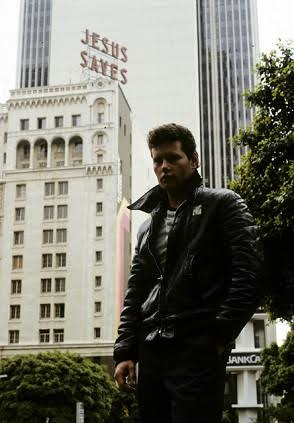
Downtown Los Angeles, circa 1983

Downtown Los Angeles, circa 1983
STMcC in downtown Los Angeles, circa 1983
Showing posts with label Movies. Show all posts

Sunday, September 22, 2019

MOTHER’S NATURE!

.
.
MOTHER TERESA
starring Olivia Hussey
2003
.
Tagline: 
“HER HEART FOUND THE FORGOTTEN, 
HER FAITH FOUND A WAY.”
.
On September 5, 1997, when Mother Teresa died, I did something that I rarely do when a person dies: I cried. I didn’t cry out of mourning for Mother Teresa; I knew that she was now getting a well-deserved rest and reward. When a person leaves their physical instrument, they are flying closer to God, so I had no reason to be sad for Mother Teresa. I cried for the world because this sorry, old, dilapidated and Spiritually poor globe had just lost one of its most prayerful and positively influential examples of Christ’s Love for His brothers and sisters!
.
I have never been Catholic, and I never will be, but Mother Teresa remains one of my favorite personal heroes. She would probably top my list of “Greatest Figures Of The Twentieth Century”. I can think of no one from my lifetime who more exemplified the manner of life that I believe Jesus Christ calls us to live. I am nothing less than astonished and severely humbled when I think of her and the women who volunteered to work as she did. As I recently wrote in an E-mail to a new friend, “There was probably no stronger woman (or man) from her generation.” The thought of her and her Missionaries of Charity really stirs my heart.
.
I gave a DVD copy of 'MOTHER TERESA', starring Olivia Hussey, to Good Friend Melanie for Christmas this year. (I gave her a couple of other good things, too, because that’s just the kind of guy I am.) But she enjoyed the movie so much that I borrowed it from her one day and watched it that very night. And I enjoyed it just as much.
.
It begins with Teresa’s “calling within a calling” when she observes how the abandoned sick are dying like dogs in the streets of Calcutta, and she receives a sign from Jesus that she is to serve “the poorest of the poor”. She subsequently embarks on an awe-inspiring journey to see the Face of her Lord in the poor, and to show them the Face of His Love in exchange. The film ends just two years before her death, when, in a revelatory moment, she realizes the folly of her Association, and in essence, rediscovers her roots; “returns to the streets” in her “disorganized” Way - in a manner of speaking.
.
Throughout this lifelong journey, Mother Teresa must overcome myriad obstacles, some in the form of human beings who, from their materialistic world-view, can’t possibly understand her mission or have faith in her intentions; and some in the form of natural hardships and the opposing work of God’s unseen antagonist. The movie gives us a glimpse of some of the “miraculous” coincidences, where somehow Mother Teresa always seemed to get bailed out of an impossible situation by an equally invisible Friend. (In actuality, there were many more miracles related to Mother Teresa’s life than are depicted here!)
.
Olivia Hussey, a real beauty in her youth but always a very serious actress, gives a very nice, understated performance. It’s a bit uncanny how much she looks like the older Mother Teresa, and it’s nearly preternatural how she mastered the aged nun’s stooped but determined walk! There are good, suitably subtle performances across-the-board, but Emily Hamilton, in the small role of Anna, deserves special mention. She played every note EXACTLY RIGHT in the poignant scene where she learns of her unfortunate fate and how she will be required to support Mother Teresa’s work in the future. And the brief scene in which she later learns that Teresa was not offering her mere platitudes was one of my favorites in the picture! (It darn near made me “moisty.” OK, it did... but just a little.)
.
My only negative observations have to do with the cinematography and musical score. I feel that the film should have imitated Mother Teresa’s life in its approach, by adhering strictly to the most simplistic or austere style. Instead, on a few occasions, we get some creative flourishes: dissolving images, artificial angles and “artistic” lighting. And in a couple of places, the music becomes a shade too dramatic or intrusive. These aspects of the film should have all been kept to the most basic level possible in accordance with the unadorned life that Mother Teresa espoused. But this is only a minor complaint on my part, and these things will not significantly undermine your viewing experience.
.
Let’s face it, it’s really impossible to cover the scope and influence of the life of Mother Teresa in a single two-hour movie, but I feel that 'MOTHER TERESA' does about as fine a job as one could reasonably expect. If you want a good overview of her life and you want a lesson in what a beneficial difference one faithful and hard-working person filled with the Love of Christ can make in this world, then by all means, make it a point to see this film. And be prepared to be put to shame, like I was.
.
“We are called upon not to be successful, but to be faithful.” 
~ Mother Teresa
.
~ Stephen T. McCarthy
.

Monday, August 12, 2019

MY, OH MY, WHAT A WONDERFUL DAY...

.
.
SONG OF THE SOUTH
starring: James Baskett, Bobby Driscoll, Luana Patten
1946
.
MY, OH MY, WHAT A WONDERFUL DAY... IT WILL BE WHEN THE DISNEY COMPANY GETS ITS HEAD OUT OF THE INKWELL AND RE-RELEASES SONG OF THE SOUTH. That day may be a long way off, however, because the shrieking unthinking have muted this SONG! And here in purified, sanitized, synthesized, homogenized, and anesthetized contemporary America, we must be protected from anything that might accidentally induce genuine contemplation and intelligent discussion. Heaven forbid this country should start thinking for Itself!
.
SONG OF THE SOUTH is important for a couple of reasons: It was the first time live action was mixed with animation throughout an entire full-length motion picture. It also represented a high-water mark of artistic achievement in the context of storytelling and moralizing. SONG OF THE SOUTH is probably nothing less than the finest example of American folk art! But America - land of the free and home of the brave - isn't allowed to see it!
.
I was very fortunate to find a copy of SONG OF THE SOUTH (in English with Japanese subtitles) over a decade ago, and have been watching it regularly since; it remains one of my Top 25 favorite films. I wish there were some way I could make a copy for everyone who desires one: I'd surely do it!
.
The overall story is a little too sketchy, but JAMES BASKETT (Uncle Remus & the voice of Br'er Fox) gives one of the most engaging performances in motion picture history. His character is the true hero of the story. Only he and Miss Doshy (Lucile Watson) have a clue.
.
So, where's the controversy? Well, 'SONG' takes place on a post-Civil War Southern plantation where the Blacks are working as sharecroppers. For the most part, everyone is happy, even singing when they work. Perhaps some feel that this whitewashes the slavery issue. And of course the Black characters speak in a grammatically butchered Southern dialect. That's historically accurate! After all, they were unjustly denied an education. But the language is far more tame than I have encountered in other old movies featuring Black characters, and in fact, no more outside of mainstream English than current ebonics. And that's the extent of SONG's controversy! OOOoooh! OOOoooh!
.
It's the same small group of maroons who would protest SONG's release that have tried for years to get Twain's 'HUCKLEBERRY FINN' banned, never realizing that Chapter XVI of that book (in which the Divine spark in Finn's heart wrestles with the callousness of his society-indoctrinated conscience and wins) constitutes the single greatest anti-slavery statement ever recorded in a novel! SONG's humanity easily outweighs any of the marginal stereotyping it commits in conveying its time period.
.
[Interestingly, Joel Chandler Harris (creator of the Uncle Remus stories) once wrote to Mark Twain and said of 'HUCKLEBERRY FINN', "It is the most original contribution that has yet been made to American literature." Later, he publicly wrote, "There is not in our fictive literature a more wholesome book than 'Huckleberry Finn.' It is history, it is romance, it is life. Here... we see people growing and living; we laugh at their humor, share their griefs; and... we are taught the lesson of honesty, justice and mercy."]
.
The handcrafted animation (no computer graphics or live action tracing) is WONDERFUL! There is one sequence in which Uncle Remus, fishing with Br'er Frog, casts his animated line directly at the viewer; it disappears above the screen, and moments later the cork splashes into the stream and bobs in the viewer's face while the rest of the line softly descends into view, landing in the water. It's the most beautiful and imaginative 12-seconds of animation ever put on film.
.
If the Disney Company realized how much money it would get by making SONG OF THE SOUTH available, it would accede to our wishes because MONEY is now what drives Disney. We must continue to dog Disney until it STOPS TREATING US LIKE LITTLE CHILDREN and re-releases SONG OF THE SOUTH.
.
WE WANT OUR CARTOONS!
CARTOONS NOW!
CARTOONS NOW!
CARTOONS NOW!
WAAAAaaaaa.......
.
~ Stephen T. McCarthy
.

Wednesday, May 22, 2019

NUN TOO GOOD

.
.
SISTER ACT
starring Whoopi Goldberg
1992
.
This past November, I was in Reno, Nevada. Mrs. Van Owen, the shuttle driver who picked me up at the airport (women are always picking me up) pointed out the Saint Thomas Aquinas Cathedral as she was pulling into my hotel's parking lot, and she said, "That's the church they used in the movie SISTER ACT." Had it been ANY other church, I would have thought: Great, now how much do the video poker machines pay out on four deuces here?
.
But it just so happens that when I was in Reno on August 12, 2001, Jesus sent me to the Saint Thomas Aquinas Cathedral (although I'm not Catholic) where I was the only White person to be found in the pews, and where I observed a Catholic mass delivered entirely in Spanish. (The only Spanish I know is "Si", "No", and some words that Ricky Garcia called me in junior high school.) I kept thinking: Nice music, Lord, but why did You send me here? It wasn't until the mass ended, and I exited the church, that He revealed His purpose: On the steps of that very cathedral, Jesus, with a "miraclette", answered an important and troubling question that I'd been praying about for an entire month. (That's a story for another review.) So when my shuttle driver mentioned that particular church being used in the movie SISTER ACT, I determined to rent the 1992, WHOOPI GOLDBERG vehicle upon my return to Airheadzona. I'm back and I did.
.
Now, I grew tired of Goldberg's sassy, mono-note shtick a long time ago ("You want me to do WHAT?! Uh-uh. You got the WRONG woman, fool!"), so I wasn't expecting much, and my expectations were met but not exceeded. I knew this thing was going to be nun too good when I saw Harvey Keitel mentioned in the opening credits. (I have a rule of thumb: "Avoid EVERYTHING with Harvey Keitel in it." But since there's an exception to almost every rule, I'll add, "except maybe TAXI DRIVER.")
.
SISTER ACT's bad habits started immediately: It opens with a scene at "Saint Anne's Academy in 1968" (with the Saint Thomas Aquinas Cathedral playing the part of Saint Anne's Academy in one brief shot. Boo! I rented THIS movie for THAT?) Here we find Deloris Van Cartier (later played by Goldberg) as a youngster being asked by a nun to name the apostles. She gives a "Fabulous" (but incorrect) answer. Cut to Van Cartier many years later performing as the leader in a girl group retro act at a Reno lounge, and showing great unhappiness at being ignored by the nearby boozers and gamblers. Is it really unusual for free entertainment on a casino floor to go scarcely noticed? Would this REALLY upset a longtime lounge singer? Wouldn't she be used to the lack of attention while on stage by now? It would be the norm; just another day, just another paycheck. We've got nonsense right out of the chute, I thought.
.
The two-bit Reno nightclub singer, Van Cartier, accidentally witnesses her boyfriend, Vince LaRocca, orchestrate a young man's murder. (HARVEY KEITEL plays the evidently sight-challenged mobster. He couldn't find a more attractive two-bit nightclub singer in all of Reno? Please!) Now Van Cartier is (a soon-to-be nun) on the run.
.
Until LaRocca's murder charge comes up for trial, Lieutenant Eddie Souther (BILL NUNN, who must have gotten the part based only on his last name) places Van Cartier in a convent under the Witness Protection Program. The hulking Nunn is horribly miscast and gives a downright embarrassing performance as a lawman. Trying to pass this guy off as a street-hardened, high-ranking law enforcement officer is like trying to pass off Garfield the cat as a police dog! Nunn plays most scenes with this goofy "oh-you-kid" grin. (Sit down, Lieutentant, before you hurt yourself!)
.
Meanwhile, gangster LaRocca - awaiting his murder trial, yet incredibly free to roam the city (What? Did he have a "Get Out Of Jail" card tucked into his "violin case"?) - and his two un-intimidating, geriatric hitmen, are trying to locate Van Cartier to enunciate with gunfire their displeasure at her willingness to testify.
.
In the convent, Van Cartier's life is adhering to the typical Hollywood formula - "the outcast finds her niche and makes good" paint-by-numbers kit. You know the gig! And we're treated to all the usual: Tough and/or cool street people in ridiculously exaggerated "tough and/or cool street people" costumes (how about just T-shirts and jeans, folks? You know, like REAL people on the street wear?); the gag where three guys simultaneously rush through a small opening and momentarily get stuck a la The Three Stooges (Har!-Har!-Har!); and of course, the obligatory and ubiquitous bit where the guys take it in the "family jewels" while the heroine makes good her escape. (The nutcracker shtick ceased to be fresh and funny about 1976, but they're still feeding it to us regularly because, you know, there's little genuine writing talent in Tinsel Town. Or haven't you noticed?)
.
There are about 101 additional problems with this act, Sisters and Brothers, but there's no point in listing them all; it's not like you're going to pay attention to anything I say anyway. (The nuns fly to Reno to rescue Van Cartier because... uhm... there was no way to telephone Reno Law Enforcement? That's just a guess on my part. "Ain't nun of ya in the habit of keeping any spare change around, pray tell?")
.
I did enjoy the clever musical arrangements, and Goldberg's prayer before supper at the convent was appropriately inappropriate. But I loved Mary Wickes in the minor role of Sister Mary Lazarus, the ancient but tough-as-General MacArthur nun. I thought she had the best lines in the movie. ("I liked my convent in Vancouver, out in the woods. It wasn't all modern like some of these newfangled convents. We didn't have electricity - cold water, bare feet - THOSE were nuns!... it was hell on earth. I loved it! This place is a Hilton.") You go, Sister! Discipline those Pillsbury Dough Boy-soft troops!
.
Still, I can think of better uses for my time than watching SISTER ACT. (Sleeping, eating, reading, and writing a negative review of SISTER ACT all come immediately to mind.) Hey, I love a fun, stupid comedy (e.g., 'The Pink Panther Strikes Again' or 'Monty Python And The Holy Grail'), but because it actually asks us to accept as plausible its preposterous scenario, SISTER ACT is dumber than a lobotomized moron with paralyzed vocal cords. Making it, of course, the ideal movie for post-literate America. Whoopi!!
.
(I hear what you're thinking: Why is he always knocking America? But I'm not! I'm always criticizing America, and there's a difference: 2 more syllables and 3 more letters!)
.
~ Stephen T. McCarthy
.

Monday, May 20, 2019

SOME OF MY FAVORITE MOVIES “B” WESTERNS

.
.
THE ROY ROGERS COLLECTION
Roy Rogers DVD Boxed Set
released: 2006
.
A lot of folks don’t know that ROY ROGERS (Leonard Slye; 1911-1998) was born at approximately where 2nd base in Cincinnati’s old Riverfront Stadium would eventually be located. How American is that? It’s a wonder he didn’t emerge from the womb draped in The Stars And Stripes, holding aloft an apple pie still hot from “the oven” and whistling ‘Yankee Doodle Dandy’ (or ‘Take Me Out To The Ballgame’). Every time Pete Rose slid into 2nd base, ol’ Roy probably thought that the Reds had scored a run because Charlie Hustle was safe at “home.”
.
Roy Rogers was one of my great heroes when I was a kid, and I can still recall the pride with which I wore my bright yellow raincoat with the black pictures printed on it of Roy (“King Of The Cowboys”), Trigger (“The Smartest Horse In The Movies"), and Dale Evans (“The Queen Of The West”). I even had a little schoolboy crush on Roy’s wife, Dale.
.
These old “B” Westerns starring Roy were so wholesome and exuded such innocence that I can’t help saddling up from time to time with my old hero and revisiting a simpler, more pleasant bygone time that won’t be riding our way again. Heaven? Well, it can’t be much better than lounging around late on a Saturday morning in cotton flannel jamas, with hot coffee, and watching Roy round up rustlers. “Look out behind that rock, Roy!” Too late. Oh well, Roy will ultimately win the fight (even if he does consistently “fall” for that leg sweep trick) because the good guys and bad guys are always clearly delineated in “B” Westerns and the good guys always win. And what’s wrong wit dat?
.
.
In 1990, my girlfriend and I self-published "CALAMITY CAT'S AND BLACK COLE KID'S UNCOMPLICATED GUIDE TO WESTERN MOVIES FOR THE SIMPLE-MINDED COWPERSON." It’s quite a collector’s item now; I’ve even heard of some copies selling for as much as ten cents! Calamity Cat and I saw every Western you can think of (and plenty that you can’t). On September 7, 1990, we drove out to the Roy Rogers Museum in Victorville, California, and since The Good Lord had taken a liking to us, we actually met Roy and Dale. I recognized that distinctive “double rolled” crown of his cowboy hat as he drove past in a van. “It’s him!” I yelled. “Cut him off at the pass!”, Calamity demanded. I was really going to attempt to box him into the parking lot with my car (Calamity and I were both temporarily insane), but he pulled over of his own volition.
.
When Roy said he no longer signed autographs, Calamity and I were crushed. He added, “But we’ll be happy to have our picture taken with you.” Yeah, sure. We watched Roy work the crowd for awhile and then as someone started to hustle him off, he stopped and said, “Wait! You two wanted a picture, didn’t you?” We couldn’t believe it! He and Dale posed with us, and Roy insisted that a second shot be taken just in case the first one didn't turn out well. (I later tried to feed Trigger a handful of oats but he refused to take a bite as he was already stuffed.) We were so eager to see the pictures that Calamity and I went to a one-hour photo joint in Victorville and waited while the film was processed.
.
Roy Rogers was probably the most famous of the old “singing cowboys”, but don’t make the mistake of thinking that the “singing” part was just a movie production gimmick. Roy was a founding member of the renowned and influential Country-Western group THE SONS OF THE PIONEERS, and he had a d*mn fine voice and really knew how to swing. There was nothing “B” about Roy’s vocals! No, sir – he was the real McCoy when it came to music. And by all accounts, one of the nicest gentlemen in the history of Hollywood. (But then there’s never been a lot of competition in Tinsel Town in that department.)
.
Although the audio/visual quality of some of these old prints is pretty ragged at times, you’re getting 20 of Roy’s classic Westerns (2 in Trucolor – which is something of a small fib) for a dern low price. Will you find a better deal anywhere? “Neigh.” Included is 1944's historic “COWBOY AND THE SENORITA” (the first time Roy and Dale appeared in a film together) and perennial favorites of the Roy Rogers fan clubs, “KING OF THE COWBOYS”, “ROBIN HOOD OF THE PECOS”, and “MY PAL TRIGGER” which chronicles the birth of Roy’s famous palomino.
.
For this little wrangler, the inclusion of my three favorite R.R. pictures alone made this DVD worth the price:
.
“HELDORADO” has Nevada Ranger Roy tracking counterfeiters in Las Vegas. It includes the quintessential old coot sidekick, GABBY HAYES (“Pershnickety females!”); the rubber-faced pre-Jim Carrey Jim Carrey, PAT BRADY, who sings the wonderfully comic “I’m A High-Strung Lad”; Roy’s great line when he rescues Dale from a locked refrigerator (I won’t spoil it); and concludes with an astounding shot of what downtown Las Vegas looked like in 1946!
.
“BELLS OF SAN ANGELO” (1942, in Trucolor) has some great songs (including THE SONS OF THE PIONEERS doing “Lazy Day” and Brady’s manic antics over “Hot Lead.”)
.
And I suppose my favorite is “UNDER CALIFORNIA STARS” (1948, in Trucolor) which in a sense is an archetypal “B” Western. It commemorated Roy’s 10th anniversary in motion pictures and he and THE SONS revisited “Dust”, the featured song in Roy’s very first movie. The story revolves around the kidnapping of Trigger, a lame little boy, Ted, and his scruffy ragamuffin dog named... what else?... “Tramp”. At one point, Trigger stomps on the face of a prostrated “inflatable” villain (HOO!-HOO!-HOO! Watch in slow motion for capital “B”, “B”ad special effect laughter) and this movie contains perhaps the meanest, most downright ornery thing Roy ever uttered on the silver screen... brace yourself now: “IT’S TOO BAD A KID LIKE TED HAD TO GET HIMSELF MIXED UP WITH A NO GOOD GUY LIKE YOU!” But don’t worry, Roy will eventually get Trigger back and get the best doctor in the country to heal Ted’s leg. Everything’s Gonna “B” OK (EGBOK).
.
Unfortunately, the Mill Creek Entertainment company felt it necessary to display their logo in the bottom right corner of the screen every so often, but really, what does that matter? I mean, you’re viewing movies in which the good guys chase the bad guys on horseback around the very same rock formations from one movie to the next (watch them boulders, some of them are like recurring characters!)
.
Nevertheless, mind your tongue around me! As I wrote in the out-of-print Western movie guide that Calamity Cat and I created: “Let me spell it out for you... I don’t give an armadillo’s tail in Texas what you think of his movies, but you best not say not nice things about MY Mr. Rogers when I’m around, lest your butt and my metal-tipped cowboy boots get acquainted!”
.
Well, ‘Happy Trails To You’ until I review again.
.
~ Stephen T. McCarthy
.

Thursday, November 15, 2018

RAZING RAISING ARIZONA

.
.
RAISING ARIZONA
directed by: Ethan Coen, Joel Coen
released: 1987
.
Now, don’t y'all get me wrong, I enjoys me an offbeat comedy as much as the next person. Heck, I myself am as “offbeat” as it gets this side o’ the cuckoo’s nest. And, yeah, I chuckled two, maybe three times during the course of this 90-minute movie. But that ain’t a good laughs-to-minutes ratio, boys ‘n’ girls. Problem is, I prefer my offbeat comedies to be funny. ...Yeah, I’m funny that way.
.
I s’pose I can see why some o' the people of Airheadzona might think this is a great comedy. After all, Airheadzona's collective I.Q. rating is commensurate with its average temperature during the dog days of Summer. But what excuse does the rest o’ yous have?
.
Not to worry - I’m a-gonna buy each and every one o’ yous a REAL, fully-developed Sense O’Humor for Christmas this year. (Provided The Comedy Store has ‘em on sale. I doesn't like to pay me full price!)
.
~ Stephen T. McCarthy
.

Wednesday, August 22, 2018

CHECK INTO THIS HOTEL

.
.
HOTEL RWANDA
directed by: Terry George
released: 2004
.
I find my time generally too precious to waste on Hollywood's soul-tainting product and therefore I visit the movie theater less than once every five years. But I had heard so many positive things about HOTEL RWANDA and was determined to see it. Still it took me until just a couple of days ago to finally get around to renting it.
.
I remember the massacre of the Tutsis by the Hutus in Africa in 1994 primarily because, while it was occurring, I was in the midst of experiencing a paradigm shift: On April 6th (the very day that the violence in Africa was initiated) I had an extraordinary and entirely unexpected encounter with Jesus Christ, and as a result, my world-view was being transformed daily during that historically important period.

.
I recall standing at the counter of a 7-11 in a grungy section of Los Angeles, my mind filled with thoughts of God's Love for us, when I saw the photograph on the cover of Time magazine in the rack before me illustrating vividly what was transpiring in Africa. I think the dichotomy of feeling the inestimable power of Divine Love for mankind, while simultaneously looking upon the grotesque hatred that mankind has for itself, indelibly burned that otherwise insignificant transaction into my brain.
.
While many have pointed to the immoral colonialism of Rwanda by Germany / Belgium as the catalyst behind the deplorable tragedy that took place in Africa, the tension between the Hutus and the Tutsis goes back much further than imperialistic influence, and it's important not to lose sight of the fact that ultimately every man and woman is responsible for what resides in his or her heart. No one can FORCE blind, irrational hatred into the heart of another person; it is the individual alone who must accept the blame for surrendering to deformed thoughts and allowing them to inspire evil acts. I'm reminded of the vow of Booker T. Washington which should stand as a guiding principle for each and every one of us. He said:

.
"[I] WOULD PERMIT NO MAN, NO MATTER WHAT HIS COLOR MIGHT BE, TO NARROW AND DEGRADE MY SOUL BY MAKING ME HATE HIM."
.
It is a genuine shame that no action was taken by any power to intervene and bring this genocide to an immediate halt. And though I often object to the liberal playing of the "race card", I'm afraid that in this instance I'll not dare contest the charge that the general apathy toward the violence was probably engendered by the fact that it was a matter between two groups of Black Africans. It should surprise no one, however, that the United Nations refused to take an active role in quelling the muderous spree, as anyone familiar with the history of that organization knows, the promotion of global collectivism is its true agenda, and tribal massacres not easily exploited for their cause fall outside the interests of the dogs of Socialism.
.
As for the film itself, it is well-directed and contains an excellent performance from Don Cheadle as the lifesaving Paul Rusesabagina; and an even more impressive performance by Sophie Okonedo who plays Rusesabagina's wife, Tatiana, a woman of grace, inner strength and beauty. HOTEL RWANDA convincingly conveys the intensity of the environment without the de rigueur graphic violence of Hollywood movies.
.
I've deducted half a star because there were a couple too many last-second rescues that strained believability for me (and I stand corrected if ALL of these situations truly conformed to historical fact, but I find that doubtful). And I charged another half a star against the horrifically miscast Nick Nolte in the role of U.N. Colonel Oliver. Nolte couldn't act his way out of a paper bag. He tried it once in 1996: The Screen Actors Guild placed him into a paper bag specially constructed for the experiment. When he was unable to act his way out of it, Nolte was rescued just as his supply of oxygen was exhausted and he slipped into unconsciousness (though some say it was difficult to discern the difference). Nolte was embarrassingly unconvincing as a colonel, as he possesses none of the mien of a lifelong military man -- he wasn't even acceptable as a commander wearing the ridiculously unintimidating U.N. powder blue beret.
.
Nevertheless, I highly recommend HOTEL RWANDA to everyone. The United Nations may be useless when it comes to preventing human tragedies, but Paul Rusesabagina (and Jesus) saves!
.
~ Stephen T. McCarthy
.

Monday, July 30, 2018

"A MOVIE WITHOUT ANY SKILLS"

.
.
NAPOLEON DYNAMITE
directed by Jared Hess
released: 2004
.
I was invited to my Sister's house yesterday to watch NAPOLEON DYNAMITE, a movie that I had heard many good things about. The movie reviewer for our local paper, 'The Arizona Republic' (more appropriately called 'The Daily Disappointment' by the former mayor of Prescott, Sam Steiger), proclaimed it the sleeper of 2004. And that's a label that might apply to many of its potential viewers. As the DVD was inserted into the player, and I settled onto the sofa, my 16-year-old niece, Shannon, who had seen the movie previously, said, "It's a pointless movie; it has no storyline." Oh, the wisdom that sometimes emanates from the mouths of babes!
.
I contemplated some of the clever and funny ways I might review NAPOLEON DYNAMITE, but decided to tackle it from an angle I seldom employ:  straight-forward. I suppose it's understandable why some kids (8 to 12 perhaps) might find this movie entertaining, but this review is a public service announcement for everybody else tempted to buy or rent this "sleeper." QUESTION: Is it fair to harshly criticize a simple little comedy? (A poor word to describe this movie, but one must categorize.) ANSWER: Yes, because it asks for $20 of your money and / or 86 minutes of your valuable time!
.
NAPOLEON DYNAMITE is a movie without any "skills", but plenty of problems. This is dynamite that only blows up in the viewer's face.
.
PROBLEM #1: I understand that the movie was originally a concept for a student film. Well, the writer / director is STILL a student, because he evidently doesn't understand the most rudimentary principles of filmmaking. A movie needs a central conflict that propels the viewer from scene to scene. This is something that most foreign filmmakers have also failed to grasp. They're still trying to put books on film, and they usually bore because novels and movies are two different mediums with unique necessities. It is possible for an episodic film to succeed, but this is exceedingly rare and requires that every scene be poignant and expand the viewer's understanding of the characters. NAPOLEON DYNAMITE simply moves from one supposedly amusing skit to another. The scenes lack dynamism and do not illustrate previously unexplored facets of the characters. And that brings up another problem...
.
THE CHARACTERS:
The principal character, Napoleon Dynamite, could best be described as a two-toned dog: 'Goofy' with the hairstyle of a poodle! It's fine to have an odd character or two, but you cannot entirely people your story with oddballs. You must have one or two "ordinary" characters to balance the relationships. Here, the only characters who are not overtly strange are simply one-dimensional bullies and snobbish school queens who appear only occasionally to act as a foil for the misfits. Consider the great sit-com, 'THE ANDY GRIFFITH SHOW': In the early days, Griffith played Andy Taylor as "a heavy-handed rural clown", and it didn't really work; there were too many of that sort in the cast. One day, Griffith said, "I just realized that I'm the straight man. I'm playing straight to all these kooks around me." The next season he downplayed his character, becoming the true heart and soul of the show. NAPOLEON DYNAMITE has no heart and soul; it is just a bunch of kooks in search of a story. And unbelievable kooks at that. The scenes between LaFawnduh and Kip were preposterous in the extreme.
.
Sure, there were a few nice moments that elicited a smile or a snicker or two from me. They did manage to convey that sense of insecurity and social ineptitude of young people (especially through the monosyllabic dialogue). Seeing Napoleon step out of his cocoon and daringly help his friend Pedro at the school assembly was the one moment in which we see some sort of genuine growth in a character. The shot of Napoleon practicing his dance moves through his partially closed bedroom door was the one artistic flair that got my attention. Nicely done. And I did appreciate the fact that here was a movie without the customary nudity and over-the-top profanity and violence. But it takes more than that to justify spending an hour and a half of my time in front of the "Lobotomizer."
.
It's clear to me that Hollyweird is now officially out of ideas. The Hollyweirdos have been reduced to making movies based on comic books (Superman, Batman, Spiderman, et. al.), TV shows (The Brady Bunch, The Honeymooners, Bewitched), remaking movies that don't need any remaking (Born Yesterday, The Longest Yard, The Bad News Bears), and trying to pass off student movies as genuine films (Napoleon Dynamite). Don't be fooled: NAPOLEON DYNAMITE is nothing more than a low-budget student movie that pretends to make some sort of statement, and imagines itself to be a "film"; it's an invisibly small-scale story that desires to be thought of as something bigger and more important. Kind of like that other Napoleon.
.
~ Stephen T. McCarthy
.

Tuesday, July 3, 2018

WAS KASPAROV A PAWN IN IBM’s GAME?

.
.
GAME OVER: KASPAROV AND THE MACHINE
Documentary featuring Garry Kasparov
released: 2003
.
Did GARRY KASPAROV, the world’s greatest chess player, get rooked when he lost a six-game match to IBM’s supercomputer, DEEP BLUE, in 1997? That’s the question that this padded but nonetheless interesting documentary asks you to consider.
.
I wasn’t even aware of GAME OVER: KASPAROV AND THE MACHINE until I stumbled over it while Amazon surfing last week. When I was unable to locate a VHS rental copy, I actually bought my first DVD player (NOT made in China, India, or Indonesia) just so I could view this.
.
If you have little or no interest in chess (the world’s greatest game!) then there is no chance you’ll find watching the 85 minutes of GAME OVER well spent. On the other hand, if chess fascinates or even interests you, you’ll find the movie flawed but somewhat intriguing.
.
I got into chess as a result of the high profile 1972, Fischer versus Spassky match. Later in 1972, I joined the chess club at my junior high school and won the club championship in a three-game match. (But interestingly, the player who most intimidated me was blind. He was a “Chess Game Wizard.”) Back then, I wanted to be ranked a Master by the age of 16, but other interests began vying for my time and attention: art, girls, and sports and/or the art of watching girls in shorts play sports! I never became more than mediocre at best in chess, but I never lost all interest in it either. Nor in watching girls play beach volleyball. : )
.
Of this movie’s hour and a half running time, likely 50% of it is unnecessary filler. We get shots of Kasparov revisiting the locales less than 10 years later; the same footage over and over of an old chess-playing contraption; shots of New York City ad nauseam, etc. As Christopher Lloyd said in the movie One Flew Over The Cuckoo’s Nest: Cut the bullshit; play the game! A little atmosphere is fine, but too much of it slows down an already slow contest.
.
The crux of Kasparov’s argument follows: After beating DEEP BLUE handily in Game One, in which the computer played a very mathematical, machine-like style, it made a “creative judgment” in Game Two which the man, Kasparov, was certain could only be made by a “man”. Subsequently, he became so unnerved -- convinced that a human mind was responsible for that move (i.e., he was playing against not just a computer, but also against one or more unseen Grand Masters behind the scenes) -- that he prematurely conceded Game Two, which possibly cost him a draw and ultimately the match.
.
If chess were purely mathematical, I -- the most mathematically-challenged person on the planet -- would have never won a game. There are rich, creative and psychological elements to chess -- it is NOT strictly mechanical, not just “black and white”, despite the colors of the pieces. It is closer to music than it is to algebra. I have no math skills whatsoever, but I’m extremely analytical and I naturally discern patterns in things. And I can be quite a fearsome psych warrior! As a novice playing against novices, I frequently swapped queens when the only advantage to me was psychological: beginners -- and even some half decent players -- will mentally surrender once they’ve lost their queen. But I KNEW I could win without her, and it only made me bear down and concentrate more. I’ve always been at my best under pressure. But does a computer “got game” when it comes to those additional chess factors?
.
When in Game Two, KASPAROV offered up a pawn (or two?) in order to gain a positional advantage in another sector of the board, and DEEP BLUE declined to take the piece, Kasparov became suspicious and lost his composure. It was as if a dog passed up ground beef because it “speculated” that there might be filet mignon three blocks away. Is a dog (or computer) capable of that kind of “thought”? Or will it immediately take the first gift offered? How can it sniff out a stratagem from a mistake? Well, Deep Blue saying, “Thanks, but no thanks” made Kasparov deeply blue. The rest is history.
.
I really wish that the filmmaker had dispensed with 15 minutes of superfluous “atmosphere” shots and spent it really analyzing that key move in Game Two. (One of the DVD’s Special Features replays all of the games with very basic commentary on each move, but no mention is made of the questionable moment in Game Two or of the importance it held.)

.
What was Kasparov really attempting to accomplish by sacrificing a pawn or two? How obvious was the advantage in position that he would have gained? How much “creative thinking” did Deep Blue have to perform in order to “see through the ground beef”? How did the computer go from mechanical playing to “humanistic” playing overnight? Was IBM playing chess games with Kasparov, or playing mind games with him? You’ll never know until you check, mate!
.
~ Stephen T. McCarthy
.

Thursday, May 10, 2018

SHORT ON STORY; LONG ON STYLE AND PERCUSSION

.
.
BLACK ORPHEUS
directed by Marcel Camus
released: 1959
.
I had seen BLACK ORPHEUS in the late 1980s and remembered being underwhelmed, but I procured a copy from my library to see it again as I’ve just discovered that I’ve been in love with Bossa-Nova music most of my life. (A long story and not worth retelling.) But my impression of the film remains mostly unchanged.
.
BLACK ORPHEUS is of course based upon the Greek myth in which Orpheus -- the offspring of the god Apollo and Calliope -- is able to tame beasts and alter nature with his music, but is unable to save his true love. In this movie, the “beasts” are represented by roosters, goats, kittens, song birds, and puppy dogs (they ALL taste like chicken), and the manipulation of nature is the belief among the poor children residing in the hills above Rio de Janeiro that the sound of Orpheus’ guitar and songs cause the rising of the sun.
.
The story takes place in the days leading up to Rio’s famous Carnival and, thus, the sights and sounds of that festive event just explode on the screen. The cinematography is a delight, featuring imaginative camera angles, compositions and movements, and gorgeous panoramic shots above and around Rio de Janeiro. 
.
I have very little desire to travel outside of the U.S. (Egypt and The Holy Land being my dream destinations), and other than a couple of misadventures South-Of-The-Border, I’ve stayed “home”. (The accommodations in a Mexican calaboose leave EVERYTHING to be desired -- another long story not worth retelling... or reliving.) But my second viewing of BLACK ORPHEUS has convinced me that an all-expenses-paid trip to Rio offered by a wealthy Brazilian woman desiring a (tired & old) kept man / love slave isn’t something I would automatically reject. Additionally, this is one of the most colorful movies I’ve ever seen; there’s enough color on the screen to turn Walt Disney from blue to green with envy in his cryogenic tube!
.
Most of the acting is of the amateur variety and it’s apparent (in ANY language). BLACK ORPHEUS sports two of the more annoying female film characters in my recent memory: Mira (played by Lourdes de Oliveira) and Serafina (played by Lea Garcia). But despite the non-professional status of their performances, Breno Mello (as Orpheus) and Marpessa Dawn (as Eurydice) are watchable: Mello for his charisma and handsome looks, and Dawn for her innocent charm and exotic attractiveness (pretty features and dark skin dressed in a crisp, virginal white dress. Yikes! Put me on her dance card!)
.
Orpheus’ true love, Eurydice, is pursued by a mysterious man (the personification of Death) throughout the picture, but nobody -- including Eurydice -- bothers to inquire why. (Ah, them Greek myths -- never overburdened by genuine character motivations.) And there are a few other problems: During the Carnival, it goes abruptly from morning light to the black of night while we’re in the midst of a single dance. (Man, the days are short in Rio, and when its Sun falls, it falls FAST!). And the story (what there is of it) periodically bogs down in excessive lingering over some sequences. (Say what you will about what a moral cesspool the U.S.A. has become, but when we tell stories well on the silver screen -- an increasingly uncommon occurrence in recent decades -- no country tells ‘em better.)
.
The truth (according to Stephen T.) is that, really, unless the viewer is paying their admission fee to vicariously experience Rio’s Carnival and/or to enjoy the complex rhythms of the Bossa-Nova beat and the simple beauty of composer Antonio Carlos Jobim's melodic lines, there isn’t a great deal of reason to spend 107 minutes with BLACK ORPHEUS. The score, however, is the main attraction here, and the payoff is rewarding if you’re a fan of Brazil’s great music. (I myself would be willing to view this movie yet again someday, just for that.)
.
I’ll add that the final scene wherein three small children begin to reprise the Orpheus / Eurydice story theme while the sun rises to illuminate them gave me a wistful, inarticulate joy -- a kind of Saudade. Their enthusiasm was infectious, making a lovely ending to a so-so movie. But, of course, we know that ultimately Enduring True Love, the “Happily Ever After”, will slip through their hands like a... well... like a myth, as it does to us all. (But I suppose that for me, living in Rio and listening to Bossa-Nova daily as a wealthy Brazilian woman’s kept man / love slave would be the next best thing.)
.
GOT BOSSA-NOVA?
[link> Bossa Nova for Lovers
.
~ Stephen T. McCarthy
.

Monday, April 23, 2018

You’ll Need A Bottle Of “MESCAL” To Get Through This One!

.
.
THE QUICK AND THE DEAD
starring Sharon Stone and Gene Hackman
released: 1995
.
In THE QUICK AND THE DEAD, Sharon Stone plays a cheroot-smoking, Clint Eastwood-mimicking 1800s gunslinger, and Gene Hackman plays Gene Hackman -- think of a wood plank; you know, something just a little less rigid and a little more emotional than Clint Eastwood.

.
For the intelligent reader, this is all the review that should be necessary. Sure, I could proceed point-by-point in illustrating what makes this movie such a putrid corpse (a real “Boot Hill” special), but frankly, it is not even worthy of a serious critique.
.
THE QUICK AND THE DEAD -- along with Jack Nicholson’s THE SHOOTING (1967) and Jane Russell’s THE OUTLAW (1943) -- represents “The Dreck Of The West” on celluloid, and it is a good example of why I completely stopped going to the movies two decades ago. I was tired of paying money to have my intelligence insulted (as well as having Hollywood’s immorality paraded before my eyes).
.
Although this movie is an empty-headed, overly-produced, ultra-dippy “cartoon” (the Biblical allusion was especially stupid and any Yosemite Sam cartoon would be funnier and equally believable), it did amply show me what I borrowed it from the library to see -- namely, MESCAL.
.
MESCAL is a frontier town movie set where numerous Westerns have been filmed. It is located near Benson, Arizona, just three miles North of Interstate 10 (exit #297) and on “the other side of the tracks.” (I’ve always wanted to say that!)

.
My brother, Napoleon, my friend, Pooh, and I sneaked into MESCAL quite a number of years back (a REAL Outlaw Trio), but I have since longed to take the “official” $8.00, 45-minute guided tour, and on a day in May, that dream was finally realized.
.
The tour begins in the large saloon built specifically for THE QUICK AND THE DEAD, and there are no phones, johns, or refreshments available. (No saltwater taffy here, folks! This is the REAL West... uhm... built for moviemaking.) Some other FAR BETTER Westerns than The Quick And The Dead that have largely or partially utilized the MESCAL set include:
.
The great [link> MONTE WALSH (1970) featuring Lee Marvin and Jack Palance. MESCAL represented both towns, Harmony and Charleyville.

.
MESCAL was Roy Bean’s Langtry, Texas, in THE LIFE AND TIMES OF JUDGE ROY BEAN (1972), and Paul Newman’s courthouse/saloon is still standing!
.
If memory serves me, it stood in for (if memory serves me) Hays, Kansas in THE OUTLAW JOSEY WALES (1976), where that old cigar-store Indian of an actor, Clint Eastwood, asked the Confederate soldiers, "Are you going to pull those pistols or whistle Dixie?"
.
And it played the part of Tombstone, Arizona, in Val Kilmer’s TOMBSTONE (1993). On the MESCAL tour, you will walk into The Oriental saloon (now an empty shell of its former self) where Kurt Russell slapped around Billy Bob Thornton and where, later, Ol’ Doc Holliday matched Ol’ Johnny Ringo’s gun tricks with a fancy exhibition of silver cup-handling.
.
The MESCAL Tour operates on a very limited schedule, so call ahead: (520) 883-0100; press menu option #7.
.
I watched THE QUICK AND THE DEAD -- filmed entirely at MESCAL -- solely to see the movie set. And if you haven’t got any gardening to do; a house to clean; children to watch; a good book to read; quality music to hear; a dinner to cook; letters to write; bills to pay; windows to wash; a dentist to see; a room to paint; a leaky faucet to fix; a friend to visit; a car to repair; a play to attend; a wife (or husband) to love; a drawing to sketch; a good movie to view; an enemy to fight; a dog to walk; a cat to kick; a geriatric to help; a mouse to catch; a fly to swat; a walk to take; dishes to scrub; laundry to fold; prayers to pray; shopping to do; a bank to rob; a supermodel to stalk; a nap to sleep; a game of solitaire to play; or a Louisville Slugger-wielding friend to batter you into unconsciousness, then by all means, I recommend that you borrow THE QUICK AND THE DEAD from your local library.
.
But be forewarned, if you do borrow it from your library and your trigger finger doesn’t hit that “eject” button QUICK enough when the movie turns stupid (which it does very QUICKLY), then this movie might render you brain-DEAD. Of course, if you actually PURCHASE this movie, then you probably already are!
.

For more information about Mescal and Old Tucson Studios, click HERE.
.
"Sneaking In Directions":
Take I-10 East out of Tucson approx. 35 miles to exit #297 -- Go north 3 miles to where the pavement ends. Proceed West up the hill to town. Be quiet so as not to wake the security guard sleeping in the old recreational vehicle.
.
~ Stephen T. McCarthy
.

Saturday, January 27, 2018

WOULD YOU LIKE TO... KNOW WHY 'HIGH NOON' IS HIGHLY OVERRATED?

.
[This Guide was written and originally posted online in August of 2005.]
.
.
~ ~ ~ ~ ~ ~ ~ ~ ~ ~ ~ ~ ~ ~ ~ ~ ~ ~ ~

"LET'S USE OUR HEADS FOR SOMETHING MORE THAN JUST COWBOY HAT RACKS!"

~ ~ ~ ~ ~ ~ ~ ~ ~ ~ ~ ~ ~ ~ ~ ~ ~ ~ ~

==================
* SPOILER ALERT! *
In order to tear this movie limb from limb, it will be necessary to reveal significant plot points. I suggest you forgo reading this guide if you've never seen HIGH NOON but think someday you will.
==================

 TIME TO RE-EVALUATE THE "CLASSIC":

HIGH NOON (1952) is considered to be one of the greatest of the classic Western films.

In his book 'Western Films', Brian Garfield writes, "HIGH NOON is an exquisite thriller about the ninety minutes before noon on the wedding day of Will Kane [Gary Cooper], ex-marshal of Hadleyville. Kane learns that Frank Miller, a killer he sent to prison, has been pardoned & will arrive on the noon train to exact revenge." That's an overview of the plot. 

'The B.F.I. Companion To The Western' comments that "the film is memorable for its careful illusion of 'real time' suspense... [High Noon is] usually interpreted as a liberal allegory of existential man faced by the horrors of McCarthyism."

There are two ways in which HIGH NOON should be critiqued: Cinematically and Politically. The first part of this guide will look at it Cinematically. In Section 2, we'll examine its political underpinnings. The movie has been registered as a national treasure with the Library of Congress, but I think this has more to do with its politics than anything else.

HIGH NOON is NOT a terrible movie. Its use of "real time" suspense to heighten the drama was a unique idea in 1952. The scene in which the pendulum of the grandfather's clock ticks off the final minutes like a metronome before the train whistle blows was suspenseful and nicely edited. But overall, HIGH NOON does not live up to the accolades and cannot withstand a careful examination. There are some significant flaws in the movie: Some of the plot devices are too contrived. Some characters defy genuine human nature. As just simple-minded escapism, HIGH NOON is acceptable, but it is hardly the "masterpiece" professional critics have made it out to be.

THE CLOCK IS TICKING:

The problems start with Gary Cooper's performance as Marshal Will Kane. Although he earned an Academy Award for it, a glance through 1952's competition will show that there wasn't much of it. In truth, Cooper's performance was one-dimensional. He plays every scene with a whimpering look on his face and a lump in his throat. We can expect the hero to be experiencing fear, but at the same time, we're supposed to accept this man as a no-nonsense, frontier lawman who previously cleaned up the wild 'n' woolly town of Hadleyville. Cooper doesn't look like he's that man. In fact, the same expression appears on his face in the opening scene when he marries the Quaker girl, Amy Fowler (Grace Kelly). He looks as if he's about to cry, both at his wedding and throughout the rest of the picture! Brian Garfield praises Cooper's acting as "possibly one of the most intense performances by any actor ever to have been filmed". Only if Cooper were portraying a man "intensely" constipated, could I agree with Garfield's assessment.

Having married the man just minutes before, Amy Fowler learns that Kane is going to remain in Hadleyville to face down Frank Miller and his three fellow outlaws intent on killing him. She is entirely incapable of understanding his reluctance to tuck tail and head for the hills like a scared little dog. Objecting to having to wait an hour to find out whether she is a married woman or a widow, she gives Kane an ultimatum: Either dash out of town with her now, or say goodbye forever. 

Did Amy Fowler just drop from the sky? Did she know nothing about this man she married? Kane was largely responsible for saving Hadleyville from its criminal element and making it a respectable place for families. He was a well-known and (mostly) admired man in the town. How come Amy Fowler seems to know less than ANY other person in the town about the character of the man she has fallen in love with? Does it seem reasonable that she should be so ready to abandon him when he chooses to remain and face his responsibility, all because she MIGHT soon find herself a widow? By leaving him, in essence she was GUARANTEEING her "widowhood" by her own actions. Bright girl that Amy Fowler!

At the first sound of gunfire, Amy rushes back to her husband from the train depot. This makes all of her earlier protestations against violence ring hollow -- especially when she picks up a gun herself and shoots one of her husband's opponents in the back. (Something even he wasn't willing to do!) Clearly, Amy Fowler's motivations were lacking any REAL commitment and her threats about leaving Kane were nothing more than a contrived plot device meant to increase the perceived tension in the story. Everything about the character, Amy Fowler, was artificial -- she was simply a device!

Another plot device intended to heighten the suspense is the fact that the townspeople leave the Marshal to face the killers alone. Each citizen finds their excuse to abandon him. While this device accomplishes its goal, it is not the least bit believable! Those early Western pioneers were, almost without exception, extremely hearty and courageous people. They possessed an intestinal fortitude that today's soft Americans can't even imagine. It is not a lily-livered individual who packs up a few belongings and crosses the plains in a prairie schooner or Conestoga wagon, travels over mountains, across rivers, braving thunderstorms, dust storms, Indian and outlaw attacks to forge a new life in a barren land. It is entirely unrealistic to believe that every upstanding man in Hadleyville would suddenly turn chicken at the approach of four outlaws!

Two incidents from history serve to illustrate this point: When Jesse James' gang attempted to rob the First National Bank of Northfield, Minnesota, on Sept. 7, 1876, the citizens (not even the fearless Western variety, but mostly Nordic immigrants) responded with armed force and sent two members of the gang to their Maker. Within days, the posse killed another outlaw & captured Bob, Cole and Jim Younger. (See the movies 'Great Northfield Minnesota Raid' and 'The Long Riders'.) 

An even worse fate awaited the Doolin-Dalton gang on Oct. 5, 1892, when they rode into Coffeyville, Kansas, with the audacious plan to rob two banks simultaneously. When the news of what was occurring spread to the townspeople, they armed themselves & shot it out with the desperados who were attempting to escape. The Doolin-Dalton gang was decimated! Bone chips are probably STILL being collected from the streets! (See 'The Last Ride Of The Dalton Gang')

The most egregious example of a false motivation comes in the form of Deputy Sheriff Harvey Pell (Lloyd Bridges). Dissatisfied because Kane has not recommended him to the town council for the recently vacated position of Marshal, the Deputy Sheriff walks out on Kane. This device, designed to leave the Marshal alone, does not work because it is not the reasonable actions of a brave lawman. If Pell really desired Kane's support in garnering the promotion, wouldn't it have been obvious that standing with the Marshal in defense of his life, when all others turned their backs, would have resulted in the commendation he sought from Kane? Bright boy that Harvey Pell! HIGH NOON has too many contrived gears to make it the least bit believable.

Having been utterly abandoned, with only a few minutes remaining before the four gunmen come for him, what do you suppose a brave Western lawman would do? Formulate some sort of plan by which he might gain an edge? Concoct a way to even the odds? No, not in HIGH NOON!  Our hero sits down to make out his Last Will And Testament. Now there's a doggedly determined Western man for you! And just what possessions is he so concerned about leaving to his loved ones? We saw him earlier leaving town in a wagon and it didn't contain much of anything other than his new bride!


THE CLOCK STRIKES TWELVE:

...and here comes Frank Miller and his 3 outlaw buddies. They know that Kane is waiting in town for them, so what do they do? They do like any smart outlaws would -- they walk right up the center of the street, just like ducks at a shooting gallery! Bright boy that Frank Miller! Had Marshal Kane planted himself in a second-story window (instead of writing out his Last Will And Testament), he could have picked 'em off like shooting fish in a barrel! (But then all semblance of realism left this picture early on!)

Give Kane credit for being smart enough to maneuver himself behind the outlaws while they come marching up the street. Now he's in a position to open fire from behind before they know what's hit them. BUT NO! Kane couldn't do that! Why that wouldn't be fair. (As if Frank Miller is concerned with fairness! Four against one -- that's called "outlaw morality".) No, the only fair thing to do is to call out to your opponent before shooting. "Heads up, boys; I'm behind y'all here!" So, what happens when Kane yells to Miller? Miller & Company wheel around with their guns a-blazing, of course. Immediately the edge that Kane had managed to establish disappears in a cloud of smoke. Bright boy that Will Kane!

To make a long shootout short -- Kane dispatches his opponents (with the help of a nicely placed bullet to the back and a clawing of Miller's face by his pacifist wife, Amy). Just as the last gunshot echoes through the streets, a stable boy pulls up with Kane's horses harnessed to his wagon loaded for the honeymoon. Kane wordlessly drops his Marshal's badge into the dusty street, climbs onto the wagon with Amy and the "bright bride & groom" ride off into the sunset together. End of "Classic" Western. Boy, they don't make 'em like they used to! Aren't you glad they don't make 'em like they used to?

THE DUST SETTLES:

We're all adults here, so let's be honest... HIGH NOON may be suspenseful toward the end, but it is certainly no "masterpiece." This is just simple-minded "entertainment". That it's been registered as a "national treasure" is really kind of embarrassing. If you want to see the "real time" suspense concept utilized far more successfully, I suggest you check out the relatively unknown Western, '3:10 to Yuma' (1957). Although it is a HIGH NOON derivative and its ending is a bit implausible, '3:10 to Yuma' is everything HIGH NOON wanted to be and more! It boggles the mind to consider that of the two, HIGH NOON came to be regarded as the "Classic." But that's probably due to its hidden "political" agenda. Shall we?...

SECTION 2 

THE HIGHLY QUESTIONABLE POLITICS OF 'HIGH NOON':

HIGH NOON has a well known reputation as a political statement. It is my belief that its political aspect is more responsible than anything for its continued celebrity. HIGH NOON is supposedly the rebuttal to "McCarthyism" from Hollywood's Liberal Left.

As a political statement, the movie is wrong-headed and rather opaque, but then Communists / Socialists have never exactly been known for their smarts and lucidity!

I am borrowing the following explanation (*with its bias evident) from the Lycos / Tripod website, which will make clear what all the fuss was about. Due to space constraints, I've had to severely edit it:

* * * * * *
By showing an example of a man who stood up to outlaws, [HIGH NOON] criticizes those who gave the names of people with left-wing political views to the McCarthyites and the House Un-American Activities Committee during the Red Scare.

The 1947-1954 Red Scare directly affected Hollywood and the movie industry, but was not limited to them. Several people in the State Department lost their jobs as suspected Communists or went to jail. Two people -- Julius and Ethel Rosenberg -- were electrocuted for their (supposed) role in a ring to smuggle atomic secrets to the Soviet Union. The federal government and organized labor were also targets of the scare.

THE HOUSE UN-AMERICAN ACTIVITIES COMMITTEE (HUAC):

This committee was not held in very high regard during the '20s and '30s, and did not do much. But starting in 1947, when the Republicans took back control of Congress for the first time in 18 years, it became active again.

During the first part of the [HUAC] hearings, the Committee called cooperative (“friendly”) witnesses and allowed them to read prepared statements. These people testified about what they knew of Communist activity in Hollywood. Representing the studios were Louis Mayer and Jack Warner. Representing actors were Gary Cooper, Robert Taylor and Ronald Reagan.
.
In 1951, HUAC reconstituted itself under the leadership of Georgia Democrat John Wood. Also, the Senate got in on the act through its Internal Security Committee under the leadership of new Wisconsin Republican Senator Joseph McCarthy. These two committees were much more reckless and indiscriminate than the first phase of HUAC. They made wild, unsubstantiated charges about hundreds of people in Hollywood and the federal government. Thus, the term “McCarthyism” is equated with the more colorful “witch hunt.”

If you “named names” and recanted publicly in front of the Committee about your Communist past, you got to keep your job in Hollywood. If you stayed silent, you got fired. If you reasserted that you were a communist, you lost your job and were subject to prosecution by the government during this period. Hollywood people, especially people who had a leftist past, found themselves choosing sides, losing friendships and holding grudges forever.
.
'ON THE WATERFRONT' (1954):

In the 1930s [Elia Kazan] had been involved with the Communist Party for a few months, but then became disillusioned with its beliefs and methods, and dropped out. In 1952 he was subpoenaed to appear in front of HUAC. He agonized over what to do, but ultimately he “named names” and denounced Communism. He angered a lot of his friends and colleagues, some of whom would never speak to him again.

Depth of feeling about Kazan’s recantation and “naming names” still runs deep in Hollywood. In 1999, when the Academy Awards people wanted to give him a lifetime achievement award, many people walked out of the ceremony.

[*An indication that Hollywood is STILL loaded with Communists / Socialists! And which I believe accounts for the rabid esteem that the movie HIGH NOON still enjoys in Hollywood. ~ STMcC]

Kazan produced On the Waterfront in 1954. Many people have interpreted the movie as a metaphor for what Kazan went through in Hollywood. The hero of the movie is a dockworker who turns in fellow dockworkers who have been instrumental in letting the Mafia infiltrate and take over the union. In the end, the informant gets severely beaten and loses family members, but ultimately triumphs over evil. Substitute the words “Communists” for “Mafia” and “Elia Kazan” for “Terry Malloy” and you have a not-so-hidden defense by Kazan for his actions in 1952.

HIGH NOON (1952):

This movie stars Gary Cooper, one of the original “friendly witnesses” from 1947 who felt bad about his role in the whole thing. The script was written by Carl Forman, who was blacklisted right after the movie came out, and did not work in Hollywood again until the 1960s. Most people see HIGH NOON as a metaphor attacking HUAC and the Blacklist, which is plausible considering the situation of its writer.

The movie is much more subtle than 'ON THE WATERFRONT'. It is the story of one man who stands up against evil and violence to defend a town that will not even defend itself. The “evil” is McCarthyism and the Red Scare; the “town” represents Hollywood; and “the marshal” is a person who would not cooperate with the whole process. The power of this movie in delivering this message was not so subtle that people did not immediately get it. One of the most outspoken anti-Communists in Hollywood at the time, actor and director John Wayne, called HIGH NOON “the most un-American movie I have ever seen.”

* * * * * *

There is much I could write concerning this topic, but space being limited here, I will make just two points :

It is important to keep in mind that although his name has become synonymous with the entire so-called Communist "Witch Hunt" era, the Wisconsin Senator, JOSEPH McCARTHY, was not personally involved in the question of Communist subversives in the Entertainment industry. That was the House Un-American Activities Committee’s area. McCarthy was ferreting out Communist spies that had infiltrated our government. (A good idea, unless you're a Commie.) For his efforts, the man was demonized unmercifully by the mass media and even many of his fellow Senators. No man has been more vilified in the United States than McCarthy. Even Jesus still fares better in America. It's almost impossible to find anyone defending McCarthy's honor.

Everyone "knows" that McCarthy was the most evil American of the 20th Century. But no one can tell you why -- other than the generalities they've heard: "Didn't he smear the reputations of a lot of innocent people by making unfounded and reckless charges about their character and Communistic associations?"

Ah, but is that true?

That's what the masses have been conditioned to believe, and since few people bother investigating the facts for themselves, they assume it to be true because they see it printed and hear it said so often.

ARE YOU READY NOW TO LEARN THE TRUTH ABOUT THE "EVIL" JOSEPH McCARTHY?

There are only two groups of people "justified" in hating McCarthy: Communists & Socialists. That is such an important statement that I'm compelled to repeat it... There are only two groups of people "justified" in hating McCarthy: Communists & Socialists.

Unless you think it's a good idea to have Communists secretly working in sensitive departments of the U.S. Government, you ought to be appreciative of what McCarthy attempted to do before he was rendered ineffective by the Powers that be -- The Wizards Behind The Curtain. McCarthy was a good man who desired to save his country; he was a "great American patriot" (in the words of John F. Kennedy) who fought the forces of Collectivism and that's why the mainstream press still hates him to this day! 
.
The absolute truth is that the Leftists did to McCarthy EVERYTHING they falsely accused him of having done to others! NO? You don't believe me? All it takes to know is a little reading and verifying. You might want to read the following books that vindicate McCarthy by revealing the truth that you'll NEVER get from the controlled mainstream media :
.
.
.
.
.
.
.
.
.
.
Or...

Why not start with a cost-free examination on the worldwide web by clicking the following link?
.
Link:
.
THE REAL McCARTHY RECORD by James J. Drummey
.
After you've been thoroughly shocked by this truth, you need to consider how many other beliefs you might currently hold that are nothing more than the result of the controlled mainstream media's brainwashing! If they could fool you this badly about JOSEPH McCARTHY, couldn't they have fooled you just as badly about many other subjects as well? Give this some serious thought!

In the final analysis, HIGH NOON must be considered suspenseful but overrated. It's simple-minded entertainment at best, and downright un-American at worst (as John Wayne claimed).

As for me... I gotta go now. It's High Noon, and I hear my Mommy calling me to lunch. I think it's Peanut Butter & Jelly samwitch again. Oh boy!

~ Stephen T. McCarthy
2005, August